
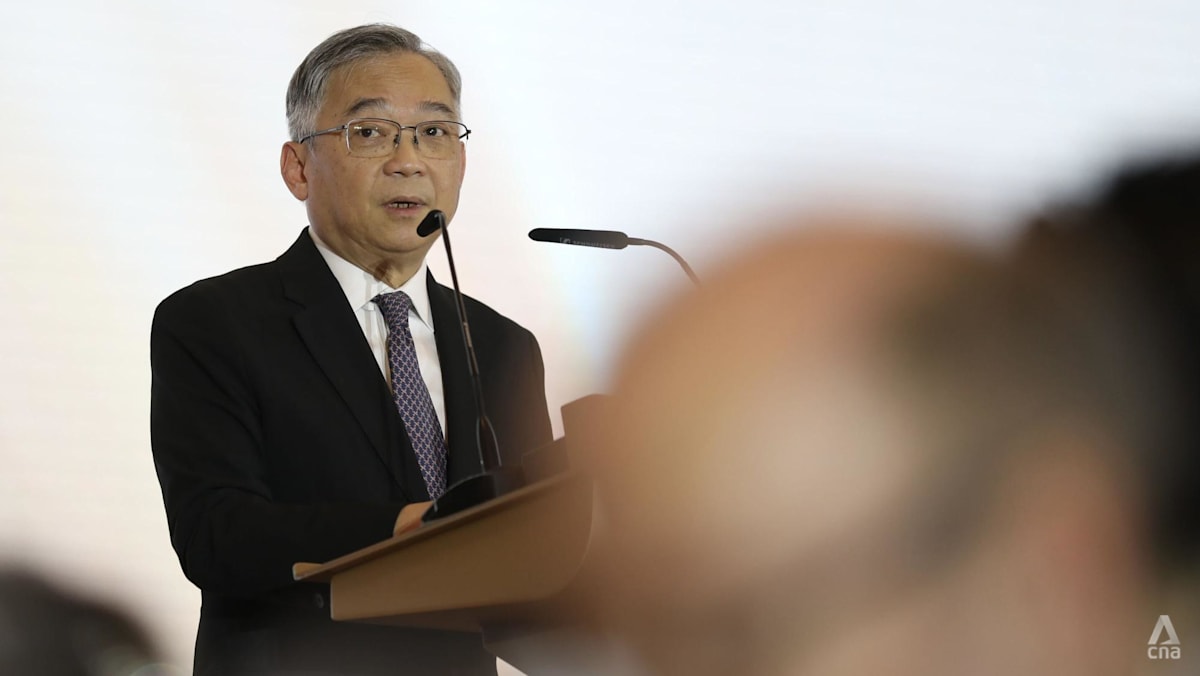
SINGAPORE: Singapore and China should deepen their innovation partnership and work together to bring new technologies to market, Deputy Prime Minister Gan Kim Yong said ahead of the countries' top-level bilateral meeting.
This includes connecting research more closely with the needs of businesses and communities, and helping promising technologies find practical applications, Mr Gan said in an op-ed on Sunday (Nov 22).
“One key factor” that has sustained the Singapore-China partnership through decades of change is the willingness of both countries to innovate together, he said.
“As our economies developed and our needs evolved, both governments have continually found new ways to collaborate.”
Mr Gan, who is also Minister for Energy, Trade and Industry (Trade), will co-chair the 22nd Joint Council for Bilateral Cooperation (JCBC) in Singapore with Chinese Vice Premier Ding Xuexiang on Monday.
The JCBC is the apex bilateral platform convened annually to review cooperation between Singapore and China.
More than 20 deliverables are expected to be concluded at Monday's meeting, spanning areas such as trade, digitalisation, financial integration, research and innovation in healthcare and education, Singapore Prime Minister Lawrence Wong said on Saturday.
At the JCBC, Singapore and China will also announce further cooperation agreements between their research centres.
Mr Gan said these would give researchers more opportunities to pool their expertise, pursue new breakthroughs and translate research into practical solutions.
DEEPENING RESEARCH AND TECH TIES
Innovation is a key priority for both Singapore and China, Mr Gan said.
Singapore has invested significantly in emerging technologies, including artificial intelligence, and is harnessing its potential in areas ranging from improving productivity among small businesses to advancing healthcare and high-tech industries.
China is similarly pursuing high-quality development through investments in science and technology, he said.
“Our complementary capabilities offer opportunities for our research institutions and enterprises to combine their expertise and develop solutions to shared challenges,” Mr Gan said.
Since Enterprise Singapore launched Co-Innovation Programmes with selected Chinese provinces and cities in 2020, more than 40 projects in AI, biomedical sciences and green technologies have received support.
“We can take these collaborations further by connecting research more closely with the needs of businesses and communities, helping promising technologies find practical applications,” he said.
Mr Gan cited Punggol as one example, where transport operators Grab and ComfortDelGro have partnered Chinese technology companies WeRide and Pony.ai to introduce self-driving shuttle services.
The services will make it more convenient for residents to reach transport hubs and neighbourhood amenities, he said.
Ahead of Monday’s meeting, three Singapore ministries have already announced memorandums of understanding (MOUs) relating to transport, green industry development and educational technology.

