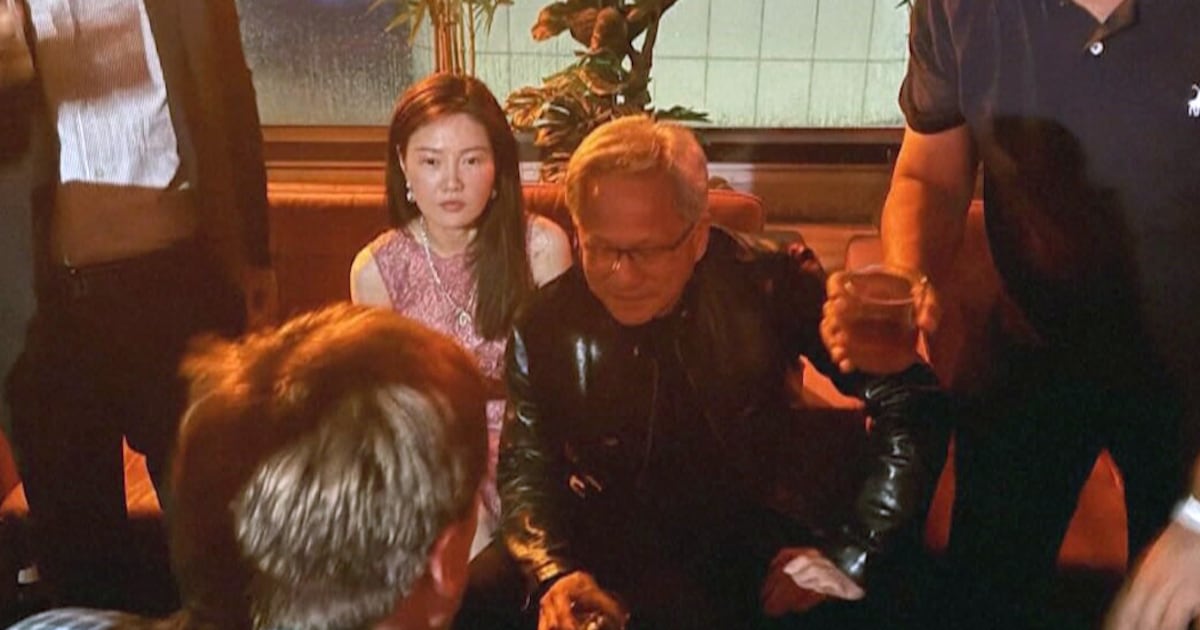
The incoming chairman of the House Intelligence Committee said Sunday that the investigation into how advanced Nvidia chips reached China should focus less on the company’s CEO Jensen Huang, and more on Alice Huang, the woman at the center of a growing controversy around the U.S. chipmaker.
“I’m a lot less interested in Jensen Huang than I am in Alice Huang,” Connecticut Democratic Rep. Jim Himes told CNN’s Jake Tapper on “State of the Union.” “Alice Huang would have been the bridge from which information flowed from Jensen Huang.”
His assertion comes as Jensen Huang prepares to testify before House and Senate committees this week after admitting to having an affair with Alice Huang, a Chinese citizen with suspected ties to Chinese intelligence. The two are not related.
“We have no idea precisely what the relationship was between Alice Huang and the Chinese Ministry of State Security,” Himes told CNN. “We don’t even know if there was a counterintelligence investigation undertaken by the FBI of Alice Huang.”
Himes said that information shared with Chinese intelligence could include where Nvidia does its research and development, the timetable for releasing advanced chips and “where’s the president going to be in China,” calling it “immensely valuable information.”
During their affair, Alice Huang is alleged to have helped facilitate the smuggling of coveted AI chips into China when she was CEO of Nvidia’s largest chip buyer in Asia, Megaspeed International, a major national security breach for the US. She has remained silent about the allegations. Jensen Huang, who resigned as CEO in the wake of the scandal, has since been reinstated by the company’s board with help from President Donald Trump.
There has been disagreement among US officials about the strength of the evidence that Alice Huang was recruited by the Chinese Ministry of State Security (MSS), the Chinese equivalent of the CIA, to spy on Jensen Huang — and, by extension, on U.S. policymakers.
Top administration officials have been evasive about the extent of counterintelligence investigations into Alice Huang and Jensen Huang.
Shortly after Nvidia’s board reinstated Jensen Huang as CEO, Trump said on social media that the US government “has no reason to believe that Jensen’s return to NVIDIA poses any risk to National Security.” Nvidia’s board issued a similar statement.
Some Trump officials, however, told CNN that it strains credulity to believe that Alice Huang was not acting as an agent of the Chinese government — simply by virtue of the fact that she is a successful Chinese businesswoman working with one of America’s most powerful companies.
Under Chinese national security law, Chinese citizens can be compelled to help gather intelligence on behalf of the Chinese Communist Party. Even if she had not done so yet, given her access to Huang — and by extension, to Trump — some officials believe she posed a clear counterintelligence risk.
But to others, the fixation on Huang’s relationship to the Chinese government has obscured broader questions around the US government’s failure to crack down on the diversion to China of sophisticated technology vital to the AI race.
On Sunday, Trump’s top economic adviser, Kevin Hassett, conceded during an earlier appearance on “State of the Union” the possibility that Nvidia could have helped China obtain advanced semiconductor chips. But he downplayed concerns about the national security risk posed by Jensen Huang
Pressed by CNN’s Tapper on allegations that Huang and Nvidia helped China access those chips, Hassett sought to minimize the impact but acknowledged it needed to “be tightened up” if true.
“To the extent that the the greatest chips — the latest chips — did a few of them get over into bad hands or through data centers that they indirectly got them into bad hands is something that, absolutely, that has to be tightened up if that’s true,” he said.
Hassett warned that if China pulls ahead in the AI race, “it could be really, really, a terrific problem for the US economy and US financial institutions.”
According to reports, two Chinese firms installed Nvidia’s powerful Blackwell chips in a Shanghai data center linked to Alice Huang.
Referring to those reports, Himes said during his interview with Tapper that is why “Alice Huang’s company is so interesting.”
“I bet we’re going to find that that company was providing training capacity on Nvidia’s most advanced chips, but doing it from Singapore,” Himes said. “There is no question in my mind that, inside China, some of the most advanced chips are training their AI today, and we’ll get to the bottom of why that is.”
Himes said the central question for Jensen Huang is simple: “What information went from you to Alice Huang, and what influence came in the other direction?”
Other lawmakers, including Republicans, shared similar concerns about Nvidia and Alice Huang.
Republican Sen. Pete Ricketts said Jensen Huang is not free from investigation.
Huang’s return “doesn’t absolve him or Nvidia from answering these questions with regard to our national security, what types of information have passed on to the Chinese?” Ricketts told Tapper during another “State of the Union” interview.
Rep. Michael McCaul, another Republican, questioned Jensen’s reinstatement by Nvidia’s board during an interview on ABC’s “This Week.”
“I know the president intervened, which is unprecedented, to put him back in that position,” McCaul said. “I think the president was concerned primarily about the economy, stock market, the CEO Jensen Huang being a leader in advanced AI chips. So I understand maybe why he did that, but I think what he did was a national security risk.”
Hassett defended the president’s decision to intervene, but added during an interview on CBS’s “Face the Nation” that “You don’t want the government telling everybody who should be CEO, but you also don’t want people getting fired because they have the wrong facts.”
Himes said he doubts the Congress will be able to get details from Alice Huang herself about the extent of Nvidia’s exposure.
“My suspicion is she’s not coming back to the states anytime soon,” he told Tapper. But, he said, she is “really the key person here.”
“She’s that bridge between Nvidia and the Chinese,” Himes said, that “we need to better understand.”