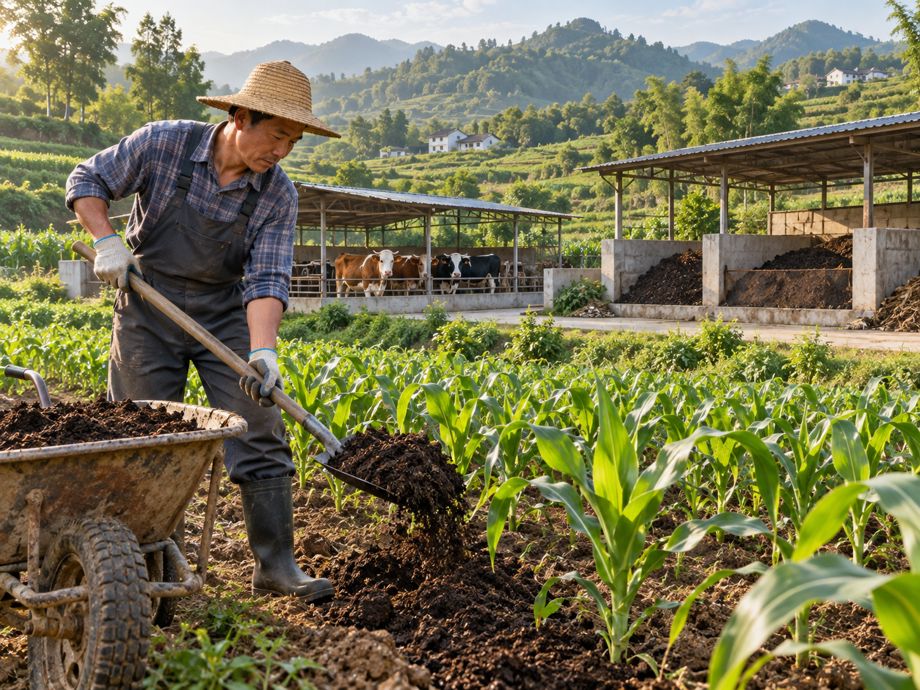
Farmers buying fertiliser and livestock producers struggling with manure disposal are often dealing with two sides of the same problem: valuable nutrients are piling up in places where crops cannot use them. A review published in Agriculture, titled "Turning Livestock Waste into Nutrient Resources: Advances in Crop–Livestock Circular Agriculture for Sustainable Farming Systems," examines how reconnecting these activities could improve soil, reduce fertiliser dependence and recover energy. Authors Bing Xiang, Jianghai Xiao and Lin Bai explain that success depends on recovering nutrients safely and delivering the right quantities to suitable farmland.
The researchers examined 93 publications, comprising 74 original research articles and 19 reviews, with their main search covering January 2021 to May 2026 and additional sources identified through citation tracking. They brought together findings from existing research to explain what works, what risks remain and how results differ across farming conditions. They did not carry out a new farming experiment or combine the findings into one overall numerical result.
Turning a Disposal Problem into a Farming Resource
Many farms now focus on either growing crops or raising animals, so nutrients no longer move easily between the two. Animal farms can produce more manure than nearby fields can safely use, and crop farmers keep buying chemical fertilisers even though manure contains nutrients their plants need. The review cites estimates that China produces more than three billion tonnes of livestock manure each year, showing how much material needs proper management.
Manure supplies nitrogen, phosphorus, potassium and organic matter, with nutrient availability depending on its composition and treatment. Organic matter can improve soil structure, water retention and microbial activity, supporting healthier growing conditions and potentially lowering fertiliser costs.
One meta-analysis cited in the review found that replacing synthetic nitrogen fertiliser with animal manure increased crop yields by 3.3–3.9% and nitrogen-use efficiency by 6.3–10.0%; these benefits were not statistically significant when replacement exceeded 60%. Another analysis reported yield increases of 4.9% for wheat and 5.5% for maize, alongside a 1.7% decline for rice, showing that results differ across crops and management conditions.
Choosing Treatment That Retains Useful Nutrients
Composting uses microorganisms and oxygen to produce a more stable material that can improve soil, making it a practical option for many small and medium-sized farms. Its ability to reduce pathogens depends on temperature, treatment duration, moisture and aeration. A global meta-analysis cited by the authors reported average losses of 28.4% of initial nitrogen and 46.8% of initial carbon, including ammonia losses equivalent to about 18% of initial nitrogen. Better aeration, suitable mixtures of carbon-rich and nitrogen-rich materials, and selected microbial additions may help limit losses.
Anaerobic digestion breaks down organic material without oxygen, producing biogas for energy and a nutrient-containing residue called digestate. Farms can recover energy and fertiliser value from the same waste, although investment, skilled operation and the expense of moving liquid digestate can restrict its usefulness. Targeted recovery technologies can capture approximately 57–86% of nitrogen and 64–87% of phosphorus from livestock slurry under reported conditions; laboratory and pilot results may overstate performance in everyday farm operations.
Emerging options include biochar to help retain nutrients, microbial treatments to improve decomposition, and black soldier fly larvae to convert manure into useful biomass and protein. Their cost, reliability and suitability for wider use need further evaluation, making locally appropriate combinations of technologies more useful than assuming one process will suit every farm.
Why Recycling Can Still Create Pollution
Spreading manure according to how much a livestock farm needs to remove can create serious problems. Excess nitrogen can leach into water, and accumulated phosphorus can escape through runoff, contributing to nutrient pollution. Application decisions need to account for soil fertility, crop requirements, available manure nutrients, weather and the amount of land able to receive them safely.
The evidence shows opportunities to reduce losses under suitable management: one cited analysis reported ammonia reductions of about 49% in wheat and maize systems, plus reductions of 12.8% in nitrous oxide and 66.7% in nitrogen runoff in maize. These figures describe specific comparisons in the underlying evidence, rather than guaranteed outcomes for every farm, and excessive substitution can reduce yields or nutrient-use efficiency.
Manure may carry pathogens, weed seeds, antibiotic residues, antibiotic resistance genes and heavy metals, creating risks that nutrient recovery alone cannot resolve. A cited meta-analysis of 94 studies reported average increases of 591% in total antibiotic resistance genes and 351% in mobile genetic elements in soil after manure application. Treatment quality matters, and energy-intensive processing can increase a system's carbon footprint even when nutrient recovery improves. Environmental assessments need to cover collection, treatment, storage, transport and field application.
Making Circular Farming Work for Local Communities
Large integrated farms can coordinate animals, crops, treatment facilities and nutrient planning, supported by machinery and substantial investment. Regional redistribution offers another route, moving manure from livestock-heavy areas to farmland needing nutrients. Local treatment and nearby reuse can be more practical for Southwest China's hilly landscapes, where scattered farms, fragmented fields and difficult transport routes make centralised systems costly; one eastern Sichuan example cited in the review reported replacement of 31–62% of synthetic nitrogen fertiliser.
Maize–soybean intercropping, green manure crops and returning straw to fields can support local nutrient cycles, provided their contributions are included in fertiliser planning. Farmers need affordable treatment, dependable manure-quality standards, transport arrangements and agreements that distribute costs and benefits fairly between crop and livestock producers.