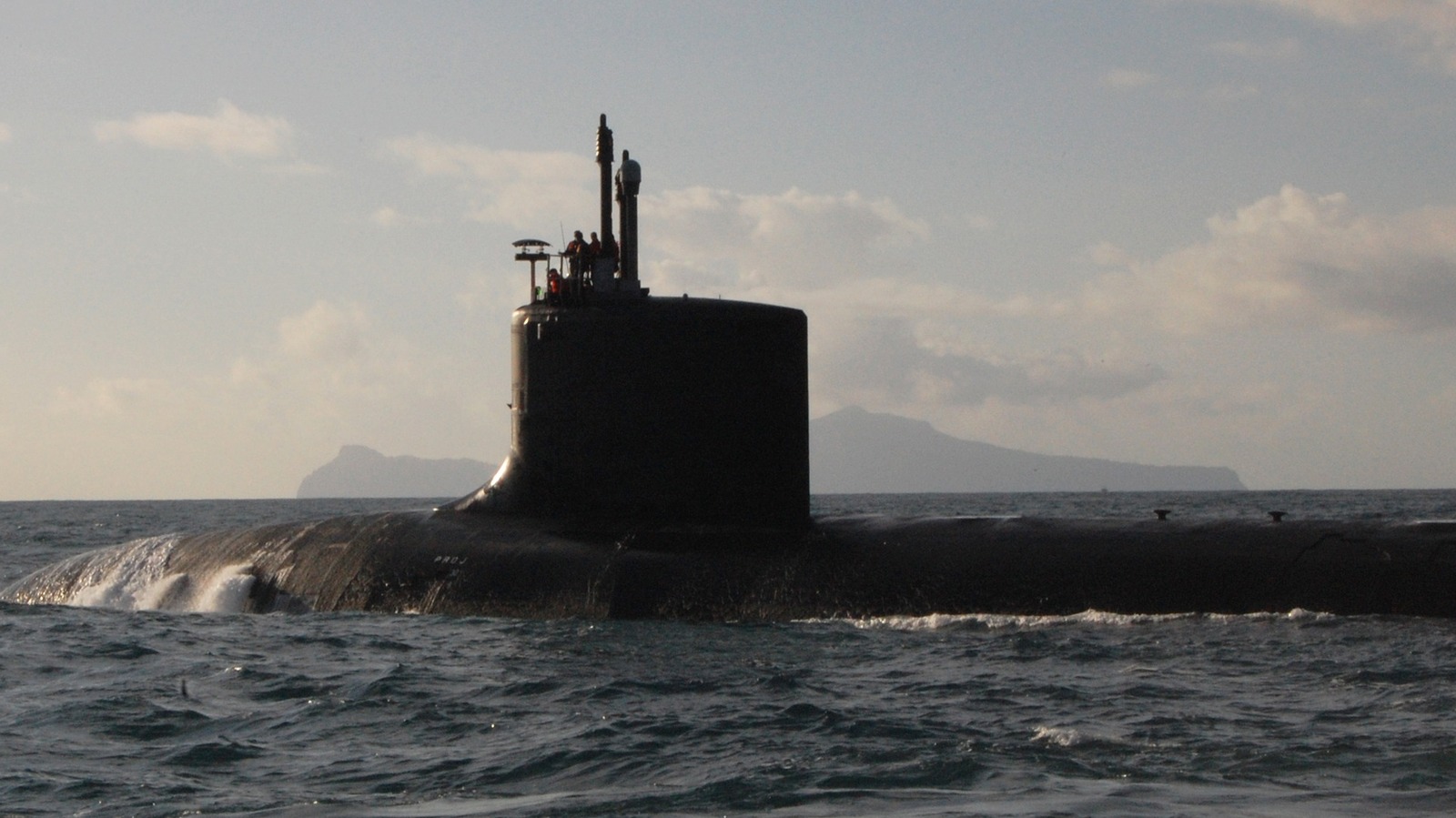
In 1954, the United States introduced the world to the first nuclear submarine, the USS Nautilus (SSN-571). Ever since, each new U.S. Navy sub has been nuclear-powered. They make up a massive submarine force consisting of more than 70 active vessels, so the Navy puts a lot of resources into their operation. Over the years, the U.S. has lost two nuclear submarines with all hands, the USS Thresher (SSN-593) and the USS Scorpion (SSN-589), though neither succumbed to enemy action.
Still, that doesn't mean that there aren't any weapons capable of sinking a U.S. nuclear submarine. In fact, there are several that could take out one of the Navy's nuclear-powered subs, and it's fortunate that none have fallen in combat. As a result, determining what has the capability to sink a nuclear submarine is limited to what is known about a sub's defenses and the weapons designed to sink them, and there are a lot when you think about it.
Looking back through history at what's taken out non-nuclear submarines with everything from torpedoes to depth charges, there's plenty that can sink a sub from a historical viewpoint. There are also several weapons that aren't necessarily designed to sink a submarine that could likely do so if employed in the right conditions. Submariners know the dangers posed to them all too well, and given the chance, each of these five weapons has the potential to sink an American nuclear submarine.
Heavyweight torpedoes
While it's well known that torpedoes are designed to sink ships, most people who haven't served aboard a submarine or studied sonar signatures might not realize that there are many different kinds. There are torpedoes designed to sink surface ships, those meant to sink submarines, and general-use torpedoes used for various reasons. When looking at modern nuclear submarines and what's needed to take them out, the faster the torpedo, the better, as it's incredibly difficult for a submarine to outrun a torpedo.
Looking at Russia and China, both nations have developed torpedoes that could sink a U.S. nuclear submarine. One of the most recent weapons developed by Russia is the Poseidon 2M39, which is a nuclear-powered uncrewed underwater vehicle (UUV) designed to carry conventional or nuclear payloads. It's also autonomous and large enough to pose a threat to surface vessels as well as submarines. The system is known as the Poseidon torpedo, but it's not a traditional torpedo. Still, its reported capabilities indicate that it would have no problem taking out a nuclear sub.
For China, one of its best weapons against submarines is the heavyweight Yu-10 torpedo. These were designed primarily for use against American aircraft carriers, but have the capability to also find and destroy submarines. Both China and Russia also use anti-submarine torpedoes in their own attack subs, each of which is designed specifically for use against their American counterparts. These include the Russian Futlyar (Fizik-2) and the Chinese Yu-6, both of which are fast, use several means of tracking targets, and carry warheads capable of sinking U.S. submarines.
Anti-submarine missiles and rockets
Anti-submarine warfare (ASW) has advanced by leaps and bounds since the closing days of World War II, and one of the most dangerous weapons against subs is anti-submarine missiles and rockets. Depending on their configurations, these types of weapons are similar to torpedoes but differ in how they're delivered. These are standoff weapons meant to keep submarines far from the ships that fire them, and they're most often deployed via vertical launch tubes.
Typically, a vessel fires an anti-submarine rocket at a target sub, avoiding its defenses through distance. Once the rocket gets close enough, it falls into the water, becoming a torpedo designed specifically to sink submarines. Russia and China both employ numerous types of anti-submarine rockets, most often fired from destroyers, which is also how the U.S. Navy operates. For Russia, one of the deadliest anti-submarine rockets is the 91R/91RT Otvet, a two-stage system that has a range of 25 to 31 miles.
They're designed to strike subs at periscope depth or on the surface, so unlike standard torpedoes, their strength lies in the ability to strike an unaware target. China's ASW arsenal is similarly significant, as the nation employs a variety of anti-submarine rockets, including the Yu-8. The Yu-8 is believed to be capable of delivering a torpedo to a distance of up to 19 miles at a speed of up to Mach 0.95 (729 mph). Once it splashes into the water, the torpedo can hunt for enemy subs up to 1.5 miles away; should it find one, it could sink its target.
Nuclear missiles and bombs
Ever since the end of WWII, a handful of nations have developed a variety of nuclear weapons, including nuclear-armed torpedoes and other devices meant to take out submarines. Thankfully, since August 9, 1945, no nuclear weapons have been used in combat, but they have been tested against a variety of naval vessels. This was done at places like the Bikini atoll (pictured), where the Navy detonated a nuclear device near a large number of decommissioned vessels, including submarines, though none were nuclear-powered.
That begs the question of whether a submarine can survive a nuclear attack. Like any weapon, it depends largely on the conditions of the attack, including how far the detonation is from the boat, whether the sub is surfaced or submerged, and many other factors. The short answer is that a submarine caught in a nuclear attack wouldn't survive if it was on the surface and well within the blast radius. There are ways that a sub can survive such an attack while submerged, as it needs only to get out of the target area as quickly as possible.
It seems logical that diving as deep as possible would keep a submarine safe, but that's the opposite of what one should do. A nuclear detonation creates a significant overpressure downwards, so survival requires rising to periscope depth and moving away from the area, or a submarine's survival is highly unlikely. Short of doing that, any nuclear submarine caught in the blast zone of even a 1-kiloton nuclear weapon wouldn't survive the attack, and both Russia and China have massive stockpiles that they could use in an all-out shooting war.
Depth charges
One of the best ways to take out an enemy submarine during WWII was to literally roll depth charges over the side of a ship. Depth charges were designed to explode at certain depths, posing a significant risk to submarine operations in the area, but they've evolved significantly since the mid-20th century. These days, depth charges look nothing like they did in previous wars and are instead a mashup of different weapon technologies designed to make submarine operation near enemy vessels incredibly dangerous. Russia has been using the RBU-6000 Smerch-2 (pictured) since the 1960s.
The Smerch-2 is an ASW rocket depth charge system introduced by the Soviet Union, and it's effective enough to remain in operation today. The remote-controlled system uses a below-deck magazine that serves the mounted 12-tube launcher. It fires rocket-powered depth charges, which are unguided explosives featuring an impact fuse and a 55-lb. high-explosive warhead. Newer ordnance utilizes a self-guiding system and a warhead capable of penetrating a nuclear submarine's hull.
For China, the latest depth charge in use is deployed by a Y-8Q/KQ-200 ASW aircraft. The self-guided depth charge drops from the plane, but many of its characteristics remain hidden from the West. What's known is that the weapons are relatively inexpensive and highly capable of striking submarines at surface or down to periscope depth. Their warheads are small in comparison to torpedoes, but because they're inexpensive, a Y-8Q could drop several in an attack on a specific sub, increasing the threat posed to American nuclear submarines.
Naval mines
The world was reminded of the existence of naval mines when Iran began placing them in the Strait of Hormuz in 2026, but they've never really gone away. Modern naval mines are significantly more advanced than the ones pictured above, as they contain intelligent systems capable of detecting passing ships before an attack. There are various types of naval mines that the U.S. Navy's minesweepers are capable of finding and eliminating, and they all pose a threat to submarines if they're not detected and safely removed from their placement location.
Naval mines are often located near coastlines in littoral combat zones, where submarines don't typically operate, but that doesn't mean they're not capable of destroying a sub in other locations. Both Russia and China use numerous types of naval mines that could pose a significant threat to a submarine, but there's one type in particular that could easily sink an American sub: nuclear naval mines. While nuclear bombs and rockets deployed on the surface pose a significant threat to nuclear subs, a nuclear-armed naval mine is designed to specifically take them out.
It's believed that North Korea is working on this technology, which makes sense given that the nation is surrounded by water from the East and West. Prior analysis of potential Russian and Chinese nuclear sea mines suggests that one could destroy a submarine from a distance of 1.24 miles. If the payload is variable, that distance could increase, and there's little a submarine could do to survive an underwater nuclear detonation within range of its hull, though these devices are unconfirmed and are only theoretical as of this writing.