
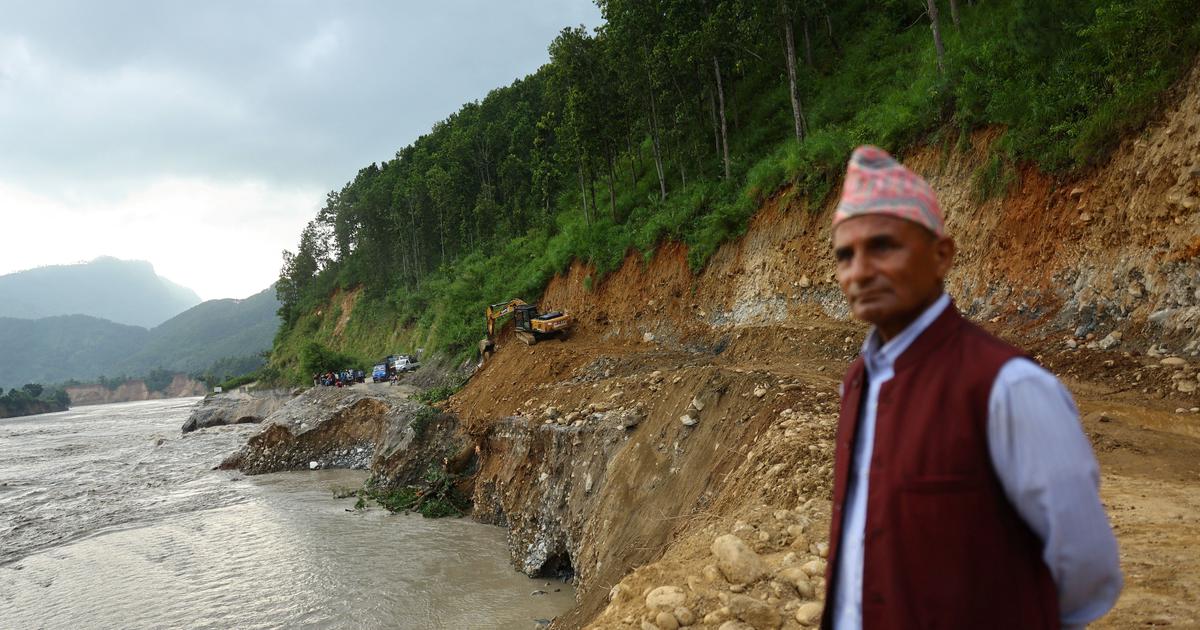
Machinery is used to clear the road along the banks of the Trishuli River in Nuwakot district of Nepal's Bagmati province on September 8.
|
Reuters
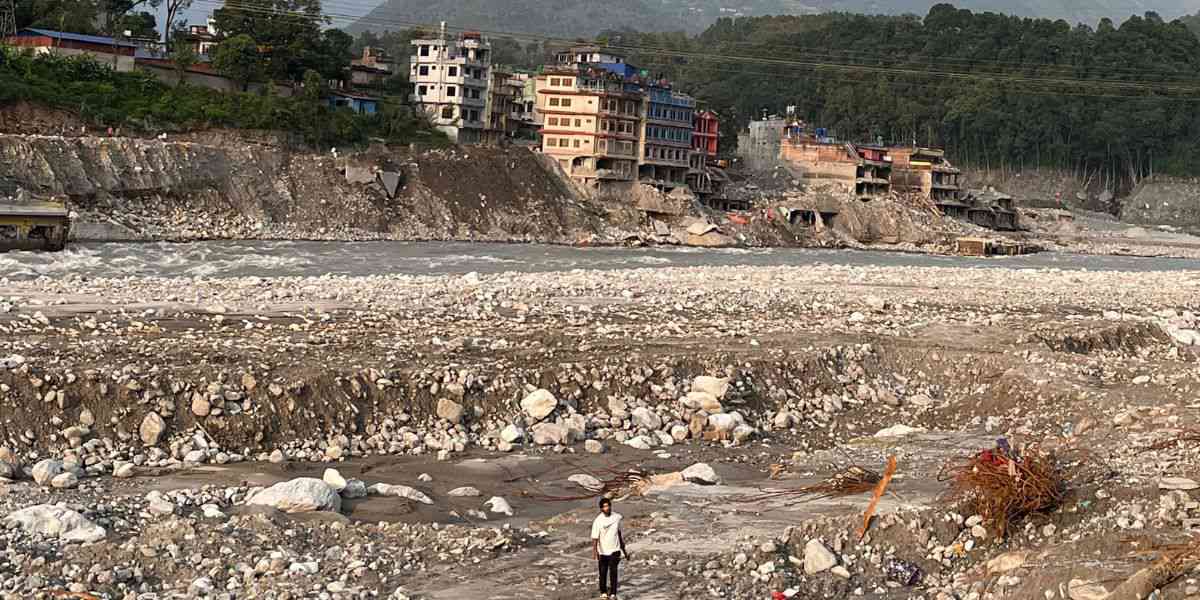
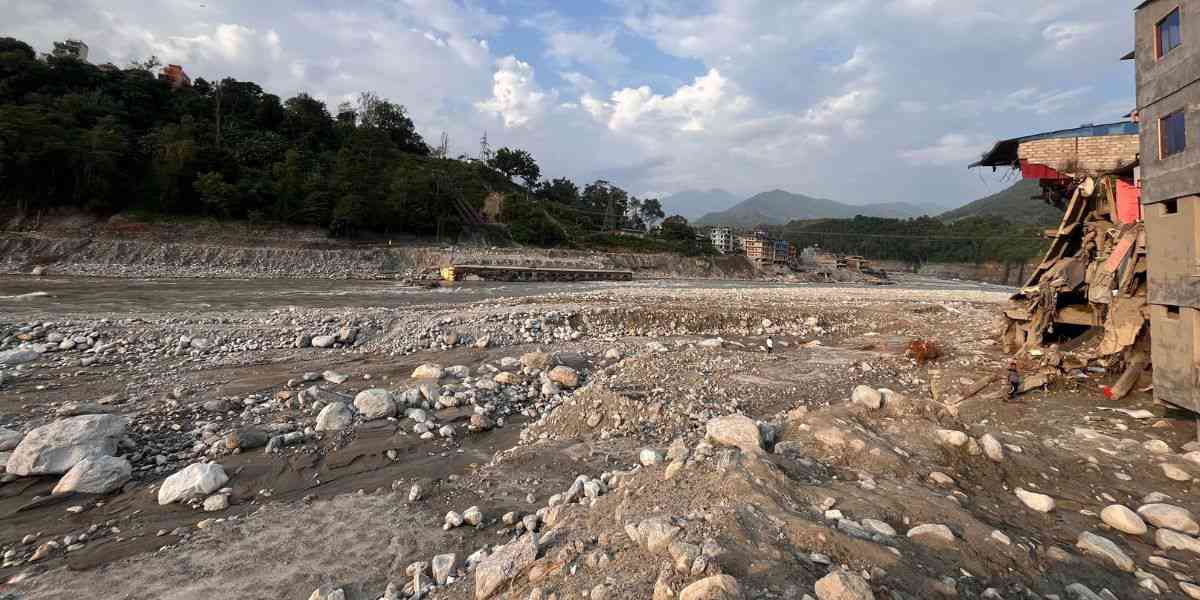
My father, Baa, and I stand on the debris of what used to be Trishuli Bazaar, Nuwakot, central Nepal. The expanse of the mud, rocks and silt spread before us, all the way down to the river. It is October and the river has now shrunk back to its regular autumn volume.
I put my arms around Baa to comfort him as he sighs.“Everything is gone,” there’s a catch in his voice.
Earlier this year, in March 2026, he had walked through Trishuli Bazaar, Nuwakot district in Nepal, entering shops, greeting passersby, shaking hands with past schoolmates, childhood friends and acquaintances. He had a spring in his step.
That was his first time back in over five decades since finishing high school and returning to his Kathmandu home to get on with adult life. My grandparents lived in Trishuli for 31 years when my grandmother was a staff nurse at Trishuli Hospital and my grandfather, a supervisor at the Trishuli Hydropower Station.
Baa would wonder why his parents abandoned the comfort of their Kathmandu life to move to Trishuli where they had to walk in scorching heat on hilly terrain to reach work, school, hospital, or the market. Settlements sprawling on the hills back the Trishuli Bazaar, overlooking the river it takes its name from. There’s a convergence of private homes, places of worship, businesses, and the hydropower station.
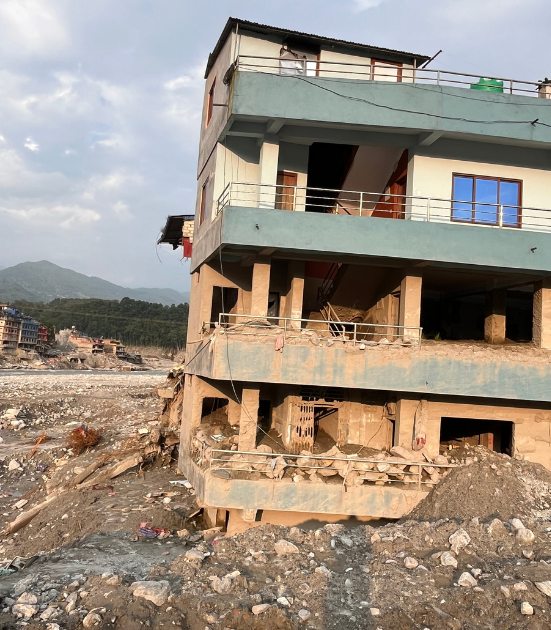
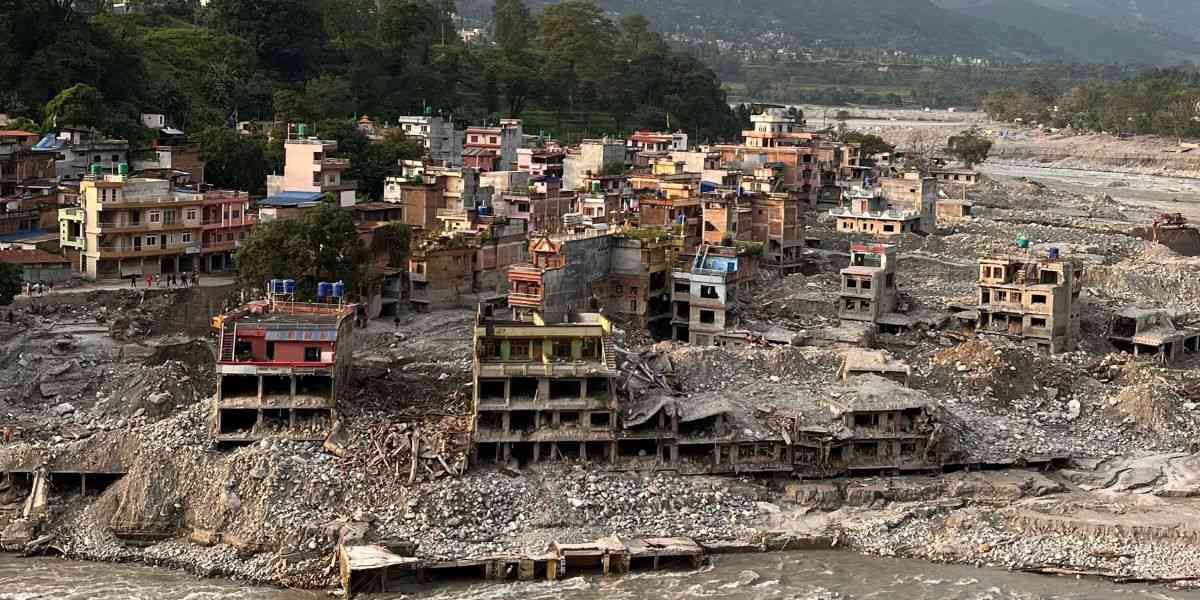
The Bhotekoshi flooding wiped out the main bazaar on 26 August 2026. Most of the settlements are gone.
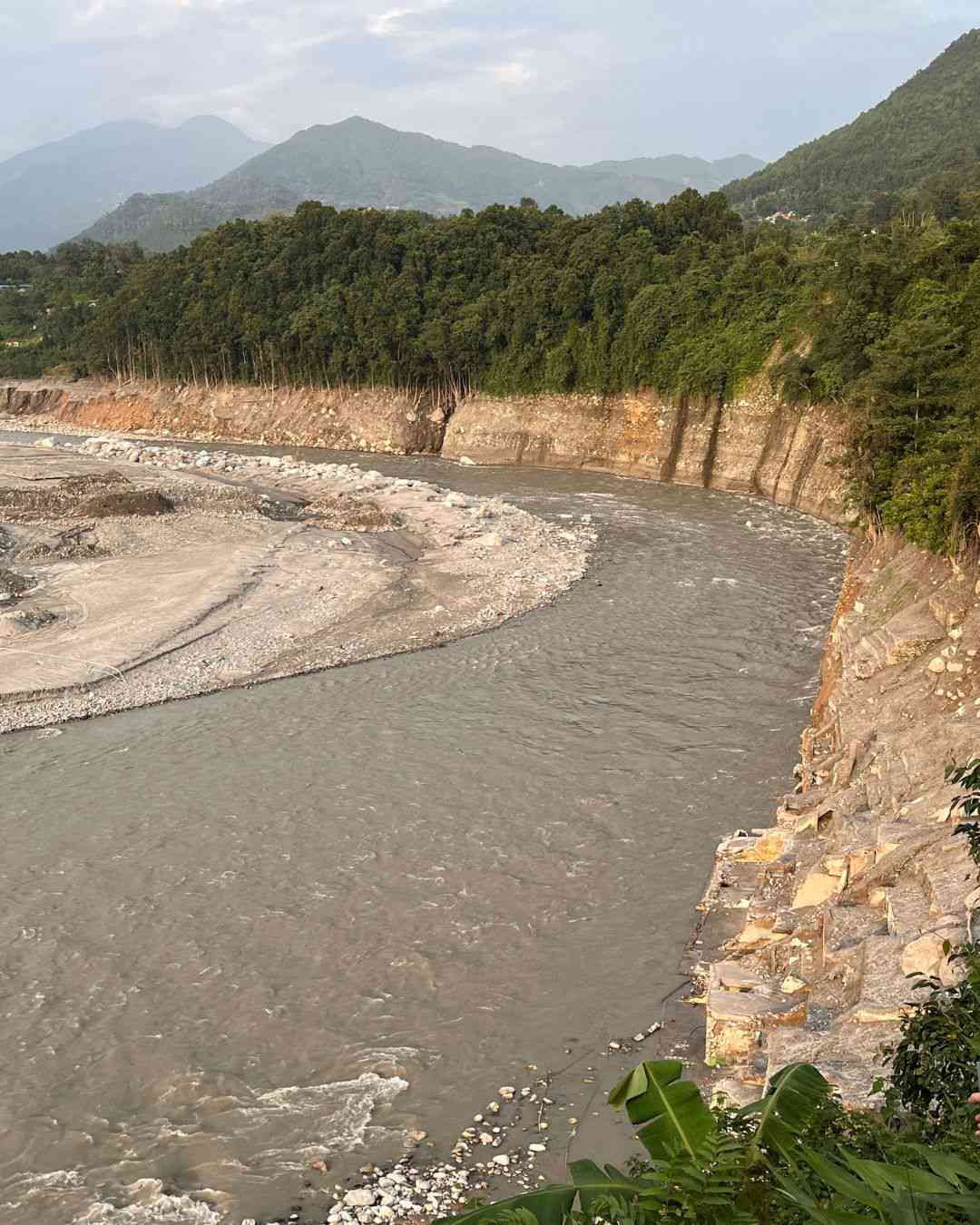
The disaster, triggered by an earthquake in Tibet, led to a large-scale ice avalanche that caused glacial outburst, sending a river of debris towards Nepal’s Bhote Koshi and Trishuli rivers.
I was back in Trishuli last month. As of October 13, the death toll was over 1,450 and nearly 5,300 people were unaccounted for with 1.6 million people affected by the disaster, according to UNICEF’s Nepal humanitarian situation report.
Five months earlier, we had gathered over lunch around a big dining table at my great aunt, Nini-Aji’s home in Trishuli. The sound of the river, barely 30 metres from the house, was the background score.
My mother asked Nini-Aji if she ever felt scared to sleep, the river so close. Aji said she was so used to the sound; she misses it every time she is in Kathmandu.
“The river must come all the way up in monsoon?” my mother asked.
“It does but never all the way up.”
When we heard about the flood destroying Trishuli bazaar, our first concern was Nini-Aji, who is 86 and uses a walker. Several hours later we heard that her son and daughter-in-law had helped her crawl across a nettled wasteland before someone drove her to higher grounds.
She and many others were moved to Trishuli colony, built when the Trishuli Hydropower was being constructed with Indian aid in 1967.
My father and his siblings spent much of their childhood at the colony because of their parents’ jobs. As a child, I would be bussed off to Trishuli during winter holidays. It was warmer than Kathmandu. Days were slow.
The colony
My grandparents lived in the colony, in one of the semi-detached houses with a spacious front porch and a big backyard where they would grow vegetables and fruits – papaya, guava, sugarcane. In winter, we ate oranges and peanuts in the sun. A man with a turban carried a big dekchi (pot) on his head, selling snacks like khuwa and gundpakl. The rice came from fields nearby, as did the daal. There was enough fish from the river.
A musician who moonlighted as a supervisor at the hydro power station, my grandfather, would play his sitar in the drawing room in the evenings. Occasionally, a friend from the bazaar would join him on the tabla or other instrument and the house would reverberate with the melody of their jugalbandi.
Trishuli living was slow and sure and without distractions. I suppose that’s why my grandparents had chosen it over Kathmandu.
On every trip, I would carry loaves of bread from Kathmandu. Trishuli didn’t manufacture bread in the 80s. In return, they would pack my bag with all kinds of koseli (gifts) from Trishuli. At the bus stand at the bazaar, my father’s childhood friend, Khursheed Kaka, would run up to the bus window and hand me a bunch of bangles – he gifted me the prettiest bangles I ever wore.
Khursheed Kaka was no more when we visited in March, but we did meet some of Baa’s other Muslim-Newa schoolmates. When they opened their mouths to greet each other, they spoke Newa with an impeccable Kathmandu accent. We also ran into Pradeep uncle, who performs as the Lakhey, the masked demon, during the Janai Purnima festival. During the visit, there were other friends Baa sat with, holding hands, promising to come back for a longer visit, oblivious to the tragedy ahead.
A former trading post for Rasuwa and Dhading districts, Trishuli Bazaar had become a society comprising people from all backgrounds. The Ram Mandir, the high school, the mosque and the vihar were along the riverside, walking distance from each other. I was always surprised by how close they were to the river; one could just sprint towards the edge and dive.
I was always equally fascinated by how the residents of Trishuli Bazaar celebrated each other’s festivals together, joining Buddha Purnima processions and the jatras, and eating together during iftar.
At the Tribhuvan Trishuli High School, we talked to students at the hostel, who had come from far flung villages in Nuwakot and Rasuwa districts. We made several stops at houses by the river, meeting Baa’s and Nini’s former schoolmates. During my childhood visits, Nini sometimes took me to a video parlour in the bazaar, to watch a Hindi flick. Later, we would climb back to the colony, Nini singing songs from the film.
Memories
For Baa, Trishuli is synonymous with so much. It was where he first saw mangoes growing on trees. It was where he bunked classes to go swimming and fishing in the river, where he first sat by the river professing his love to a school sweetheart, where he stole guavas with siblings and friends, where he heard his first ghost story, and where many nights, he held the torch and followed his mother to the homes of villagers in pain.
For me, it was a summation of the memories of my family members who had lived there.
On our trip in March, my mother marveled at how pretty and green Trishuli had become. It contrasted with her memories of the barren red clay hills rising above the colony, where she lived for a while as a newlywed. For a Kathmandu-bred, the sweltering hot climate only reminded her she was too far away from home. She missed her siblings; the bare red clay hills and the blinding thicket of trees around her were a reminder of her desolation.
But that image of Trishuli now changed for her. The denseness of trees in the colony had expanded to cover the bare hills nearby. All around Trishuli Bazaar, there were solid roads and nice hotels. The new bridge looked sturdy. There were mobile phone stores, marts and kitchenware. Some fancy dress stores catered to Rasuwa residents, displaying silken wanju-bakkhu and woollen kullu caps. The jewelry shops had some of the most intricate designs we ever saw.
After the floods, my mother talked about how she felt as if she had gone back only to impress upon her mind “a pretty picture of Trishuli before it was all wiped out.”
In March, as my brother drove us past the new Trishuli bridge, I craned my head to look at the river, feeling squeamish. I have always felt a deep sense of fear near roaring rivers, like the sound comes bearing premonition.
In 2012, my mentor, DJ Clark and I had followed Pradeep Mool, a specialist at ICIMOD, the International Centre for Integrated Mountain Development, to the China-Nepal border in Rasuwa for a story (The River that Rages) about imminent GLOFs, glacial lake outburst floods.
The warning about potential damage left my hands clammy as I interviewed Tamang residents along the border. The region had seen flash floods in the past and resettled – as though awaiting another cycle of disaster, then recovery.
A few years later, fellow journalist Rajneesh Bandari and I had followed the route again to work on another story on GLOFs. Ishwar Shrestha, a hotel owner in Bahrabise, Rasuwa, had asked if flash floods were real. Even if they were, he said, he would never be able to abandon his home because where would he go?
When we awoke to the horrific news of Bhotekoshi flooding in August, it was Ishwar Shrestha who first came to mind. Many in the region might have shared his sentiment as they fled their homes that day. And many found it hard to leave homes they had built with their lifetime’s savings.
A house means everything in weather conditions that are harsh and in an economy that has little to offer the poor. Therefore, many return, build at the very spot of disaster because there is nowhere else they can afford to build. There’s only so much to abandon, as well as to return to.
From the moment the Bhotekoshi disaster struck, Baa was glued to his phone, trying to contact relatives and childhood friends. Phones were down and updates were sketchy. He managed to speak to just one: Dhruba Shrestha Uncle, who limps from a road accident injury and needs assistance walking. In March, Baa and he sat at his little shop near Tribhuvan Trishuli High School, their hands gently resting on each other’s knees, conversing, planning another meeting.
In August, his son helped Dhruba Uncle evacuate to Trishuli colony from the bazaar as the flood filth surged. His wife, halfway during fleeing, decided to run back to the house in a moment of frenzy to bring the five lakh rupees in cash they had been saving for their son’s wedding.
“We couldn’t find my wife,” Dhruba’s uncle told Baa. “She and the house are gone. There’s nothing to say. We are without an address.”
The aftermath
During our October visit, Baa stands at a distance and watches me speak to Buddha Maya Tamang – a 13-year-old whose sister was swept away along with their home in Betrawati, Nuwakot. She and others who were displaced have been relocated to nearby government schools. But the new life comes with the challenge of navigating memories of the one they were forced to leave behind.
UNICEF figures estimate that over 32,000 children are impacted by the floods. Many of them are living in holding centres. Some who were orphaned have moved in with relatives. For many, it’s a long wait before they can be housed with a family.
“I used to like the thought of becoming a teacher, but right now, I don’t know,” Buddha Maya says.
“She used to be a bubbly child, but has changed completely since the flood,” explains Sabitri Magar, a school assistant, who has known Buddha Maya since she was in kindergarten.
Since nature changed its course after the flood, Trishuli river flows at the threshold of Sabitri’s home in Betrawati. They can no longer live there. The family had earlier moved to Betrawati from Katichap after being displaced by a landslide: “It’s like we are being stalked by disasters.”
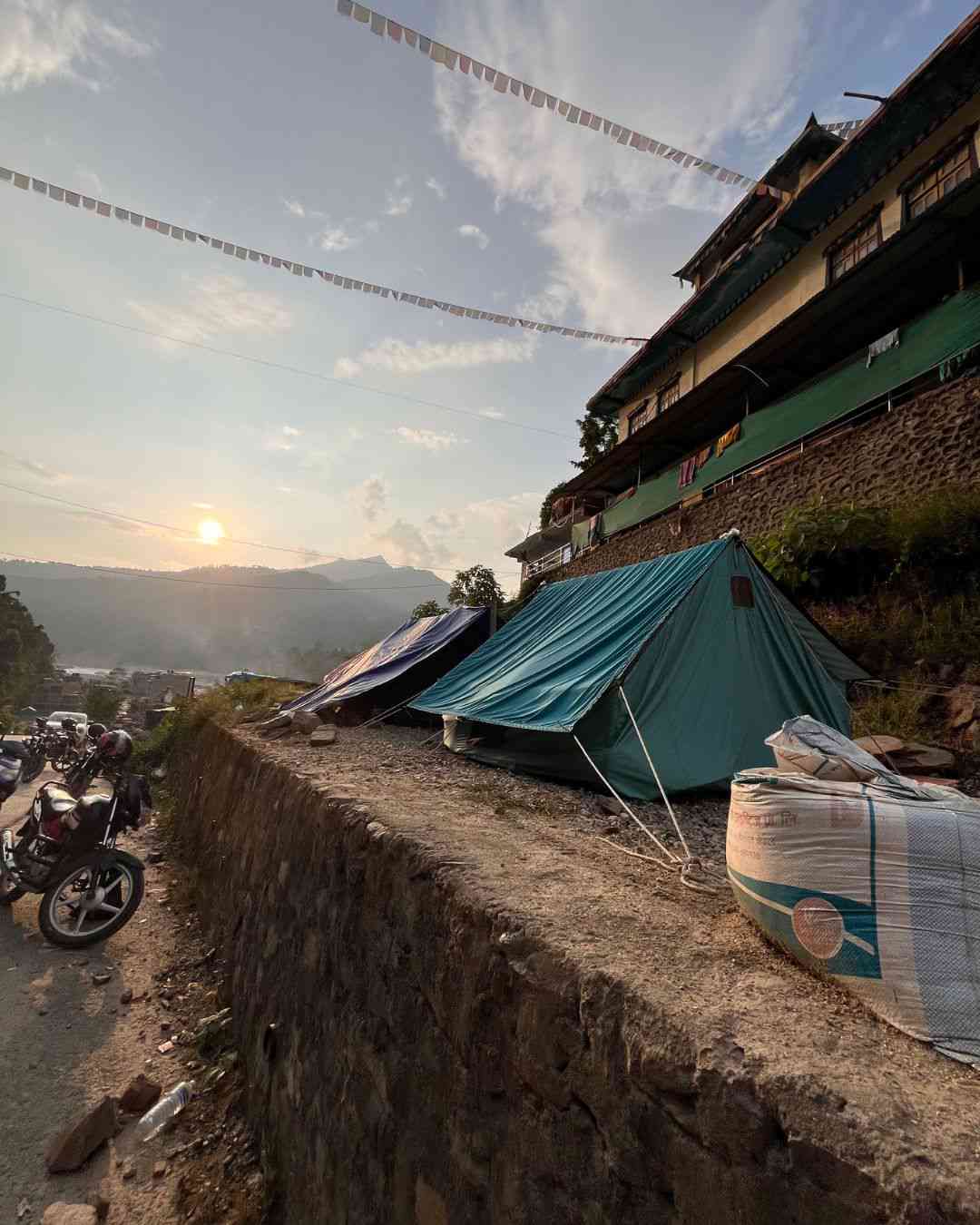
Sabitri currently lives with her four children in a rented room in Batar. But rents have doubled since the flood with the influx of homeless people. In some places in Nuwakot, the displaced live in tents. As the winter sets in, they will have to find warmer accommodation.
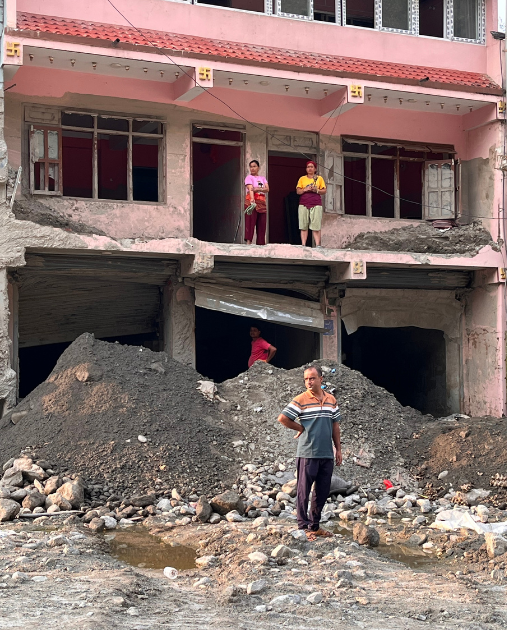
Many are so desperate that they have started cleaning up their old homes to try and move back in, even though these flood-ravaged homes are not safe. As with all disasters, relief distribution has not always been fair. There are challenges of language, reach, access to authority and the displaced persons’ inability to articulate.
“People have received enough dry food and clothes in donation now and that’s not even the need anymore,” says Bhawani Panta, school teacher. “What people need is money to buy medicines and other essentials. Most of all, they need homes. Those in authority need to hurry up.”
Pratibha Tuladhar worked for nearly 14 years with Kantipur Television. She recently traveled back to Trishuli, a town destroyed by the floods in Nepal. A shorter version of this piece was first published by Nepali Times, where she currently writes a column.
This is a Global Southasia syndicated feature.

