
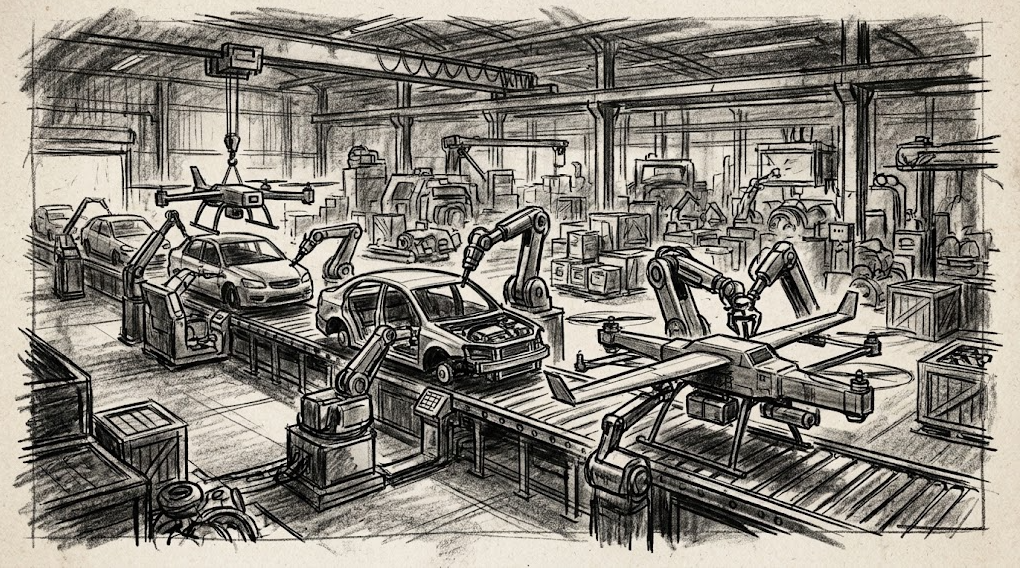
A Chinese international relations scholar says reported Pentagon talks with General Motors and Ford to mass-produce military drones expose deep structural weaknesses in the U.S. defense industrial base after decades of manufacturing offshoring and post-Cold War consolidation.
In a commentary published Thursday in the state-affiliated Global Times, Zhang Guoxi, an associate professor at the School of International Relations at Sichuan International Studies University, examined why the world's largest military spender is seeking manufacturing help from commercial automakers. His analysis reflects growing scrutiny among Chinese defense and policy researchers who view unmanned systems and industrial mobilization capacity as decisive factors in modern conflict, even as Beijing accelerates its own push into heavy transport drones, artificial intelligence-driven aerial networks and swarm control technologies.
Zhang's commentary responded to a Nov. 24 Wall Street Journal report stating that the U.S. Defense Department is negotiating with GM, Ford and other automakers to ease shortages of unmanned combat equipment. According to Zhang, the outreach highlights both a shift in modern warfare doctrine and the erosion of American manufacturing depth.
For years, the U.S. military pursued a doctrine of "winning through technology," prioritizing performance and technical sophistication over volume, Zhang wrote. However, the large-scale deployment of low-cost drones in the Russia-Ukraine war jolted Washington into recognizing that production scale and affordability are essential to sustaining prolonged, high-intensity wars of attrition.
While innovative U.S. drone startups have emerged in recent years, Zhang noted that most lack the experience and factory infrastructure required for mass production. By approaching century-old automakers, the Pentagon hopes to tap mature assembly systems, cost controls and supply chain management to compensate for bottlenecks across the domestic drone sector.
Zhang acknowledged that civil-military industrial cooperation is a longstanding American tradition, citing the mobilization of automakers as the "Arsenal of Democracy" during World War II and dual-use technology programs during the Cold War. Yet he argued that repeated recent Pentagon appeals to civilian factories, spanning artillery shells, missiles, tactical trucks and now drones, point to a deeper structural dilemma.
Following the Cold War, shrinking defense orders triggered sweeping mergers across the U.S. defense industry, while surviving contractors trimmed excess capacity to protect profit margins, Zhang wrote. Over the same period, decades of manufacturing offshoring hollowed out not only defense production lines, but also lower-tier suppliers, skilled industrial workers and accumulated manufacturing know-how. Neither the Pentagon's $1.1 billion "Drone Dominance" initiative nor Trump administration plans to inject capital into domestic drone firms can quickly reverse that industrial shortfall, leaving defense planners to "borrow a hen to lay eggs," he said.
Even if the Pentagon offers lucrative contracts, Zhang argued that U.S. automakers operating in peacetime face three calculations that explain their mixed response and the absence of signed agreements. Economically, legacy automakers locked in fierce global competition over electric and smart vehicles must weigh whether diverting capital and engineering talent into military production makes financial sense. Reputationally, global consumer brands like GM and Ford risk backlash if they become known for manufacturing lethal weapons amid ongoing humanitarian crises in the Middle East. Politically, executives must consider heightened Democratic congressional oversight following the 2026 midterm elections and whether current administration procurement pledges will secure funding ahead of the 2028 presidential race.
For Chinese analysts, highlighting U.S. industrial bottlenecks reinforces Beijing's view that future aerial competition hinges on pairing military requirements with deep commercial supply chains and rapid technological iteration. Under China's 15th Five-Year Plan, policymakers have designated aerospace as a strategic emerging pillar industry while explicitly backing research into swarm intelligent control and integrated space, air and ground communications networks.
Recent disclosures from Chinese state media and aerospace institutes illustrate how Beijing is scaling that ecosystem across heavy logistics, long-endurance surveillance and automated operations. Earlier this month, Chinese developers completed modular pallet cargo drop trials for the Changying-8, a domestically built 7-ton-class heavy transport drone capable of carrying a 3.5-ton payload over more than 3,000 kilometers and operating from high-altitude plateaus or runways as short as 200 meters. Days earlier, the 11th Academy of the China Aerospace Science and Technology Corporation conducted the maiden flight of the Qingqibing, or Light Cavalry, a solar-powered drone with a 30-hour flight endurance that launches from a vehicle after 20 minutes of preparation to support persistent communications and remote sensing.
At the same time, Chinese state utilities, forestry researchers and local police forces are normalizing large-scale drone operations across civilian infrastructure. State Grid crews in Gansu province recently put 200-kilogram-payload heavy-lift drones into routine service hauling power line materials across steep mountain ridges, while the Chinese Academy of Forestry is procuring specialized large AI models to pair with ecological survey drones. Municipal public security bureaus in Zhejiang, Hunan and Shandong provinces have simultaneously deployed autonomous drone nests, low-altitude sensing stations and air-ground traffic patrols while enforcing mandatory real-name registration and altitude controls to manage increasingly crowded skies.
By contrasting China's expanding civil-military drone supply chain with Washington's struggles to enlist commercial automakers, Zhang's commentary underscores a central theme in Chinese strategic thinking: in an era of high-attrition unmanned warfare, industrial scale and manufacturing readiness carry as much weight as laboratory breakthroughs.

