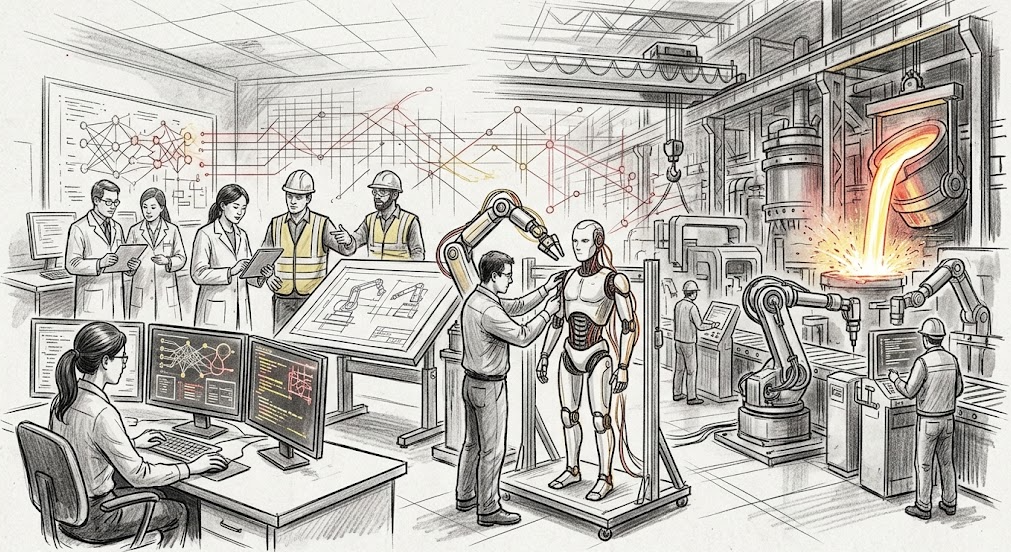
At the 2026 Embodied Intelligence Industry Achievement Exhibition and Launch Conference in Beijing this week, industry experts and former state science officials met to address manufacturing bottlenecks and market opportunities for domestic high-end equipment.
The conference highlighted a systemic shift toward production-ready automated platforms designed to minimize human exposure to hazardous operational environments. A prominent developer at the event, Shenmou Technology, introduced its Fu'an intelligent humanoid worker robot. The platform is custom-built to operate within high-voltage power distribution rooms and medium-to-high voltage substations, automating electrical maintenance tasks that carry severe electrocution risks for human personnel. Alongside the specialized humanoid, the firm introduced heavy-duty logistics systems, including a commercial industrial drone boasting a standard hauling capacity of 600 kilograms and a maximum lifting threshold of 1,100 kilograms.
The expansion of these heavy hardware systems depends entirely on stabilizing the domestic supply chain for precision parts. To mitigate long-standing dependencies on imported sub-assemblies, local developers introduced high-load integrated joint modules and piezoelectric six-dimensional force sensors engineered specifically for humanoid chassis. These localized components are built to withstand extended operational runtimes and high-frequency impacts, resolving historical supply vulnerabilities in the domestic robotics sector.
Scene-driven innovation and market integration were further demonstrated at the Maker China Hangzhou regional innovation trials, where 12 specialized development teams presented field-verified applications. The competitive trials emphasized tech solutions designed to answer specific, real-world operational problems rather than basic theoretical models. The current wave of innovation spans multiple critical defense and commercial fields, beginning with frontier defense systems where the development team Tiexue Shoujiang introduced an all-terrain bipedal humanoid robot designed to deploy along remote border security corridors. Equipped with a biomimetic constant-temperature interaction system, the platform is engineered to mitigate extreme environmental patrol risks for human personnel.
Addressing core components and supply chain vulnerabilities, Luorixike showcased its localized production path for planetary roller screws, a critical component representing nearly 20 percent of a humanoid robot's total manufacturing cost that has historically relied almost entirely on foreign imports. At the same time, Tuling Robot, a venture established by a Zhejiang University engineering team, introduced Turing OS. This modular software serves as a universal brain capable of coordinating motion control across distinct physical forms, including bipedal humanoids, quadruped platforms, and industrial mechanical arms working within automated inspection facilities.
Highlighting practical commercial viability in logistics, Duoyi Innovation showcased an autonomous low-altitude maritime delivery system. Operating over the coastal waters of Zhoushan for two years, the drone network completed over 500 maritime service orders, reducing delivery costs by up to 70 percent while improving logistical efficiency up to tenfold. In consumer services, Yiqi Future introduced an automated massage robot that has scaled across 86 percent of China's provinces, serving over 350,000 users.
To keep these high-value projects from stalling during early commercialization, regional development groups and state-backed asset networks are establishing dedicated financial frameworks. In Hangzhou, investment groups are pairing finalist teams with specialized scene managers to clear regulatory barriers and match technology with public infrastructure needs. Furthermore, participating ventures receive prioritized access to regional investment funds and continuous roadshow exposure. This comprehensive approach ensures that foundational engineering projects successfully cross the commercial divide to become standard industrial tools.