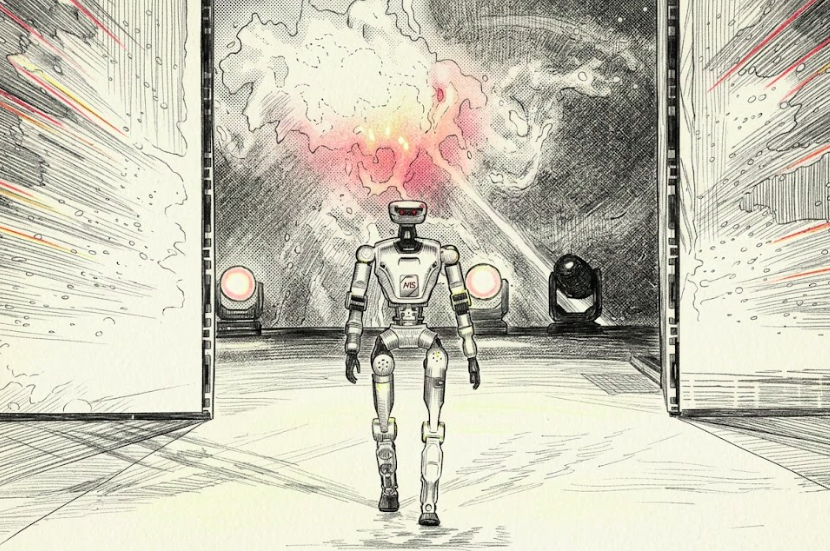
Chinese robotics manufacturer Shiyun Technology rolled out its first production line of full-scale humanoid robots on Thursday, marking a key milestone in the commercial deployment of industrial automation across high-risk environments.
The industrial-grade robot, designated the RD3 Ultra, stands 174 centimeters (5 feet 8 inches) tall and features a hybrid magnesium alloy and carbon fiber frame. Engineered by Tianjin-based Shiyun Technology for continuous 24-hour operation, the machine is designed for station duty, industrial operations, specialized inspection, scientific training, environmental survey, and emergency response.
Company officials described the model as an autonomous system built to navigate complex environments while maintaining high operational safety standards.
"With the official roll-off of the first RD3 Ultra batch, our core product system has matured," said Cao Keqian, Chief Executive Officer of Shiyun Technology.
The company reached mass production just months after establishing operations in Tianjin's Hexi District, aided by fast-tracked government approvals and access to municipal testing environments. Shiyun Technology is currently collaborating with local authorities on real-world applications, including a joint project with the Hexi District Fire Department to develop quadruped robots for fire risk inspection and rescue planning, as well as a partnership with Tianjin Rail Transit Group to deploy intelligent maintenance systems across rail networks.
The assembly facility is located inside the 764 Embodied Intelligence Industrial Theme Park, a revitalized site formerly occupied by the Tianjin Broadcast Equipment Factory. The industrial park now houses more than 10 technology firms—including Pasini Perception Technology, Shiyun Technology, and Haishen Robotics—forming an integrated supply chain spanning data collection, model training, complete unit manufacturing, and field deployment.
District officials have incorporated embodied artificial intelligence into Hexi’s broader industrial modernization strategy, aiming to establish a regional robotics manufacturing hub. Local authorities plan to expand industry partnerships, introduce flexible leasing structures to lower deployment costs, and connect local robotics firms with research teams at Tianjin University and Nankai University to accelerate commercialization.