The Digital Source For China's Tech Innovation Since 2000

Who Gets to Write the Rules on AI?

August 19, 2026
ChinaTechNews.com Staff
image

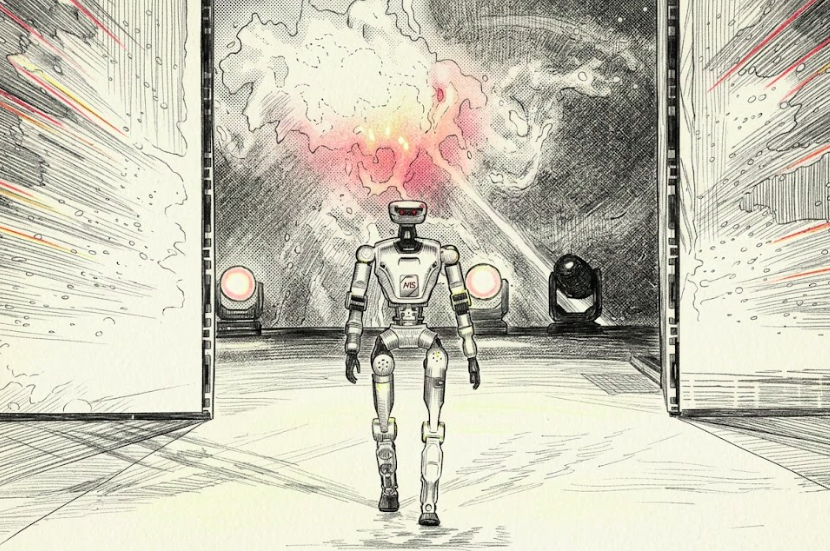
Illustration: Tyler Comrie

So many people had signed up for China’s premier artificial-intelligence expo in mid-July — over 200,000 by some estimates — that the ticketing system had crashed. A mob of frustrated AI enthusiasts had formed outside as a result. “How could they do this to us?” one woman cried. “Report the venue! Dial 12345!” a man hollered, evoking the Chinese equivalent of 311. A decade ago, people around the world traveled to Silicon Valley to glimpse the future. These days, they come to China. Inside the expo spanning more than 14 football fields, visitors watched robot workers assemble other robots and wandered along walls of computer chips made entirely without any American parts.

This year’s World Artificial Intelligence Conference arrived at a moment of peril and opportunity for AI. Anthropic claimed that its most powerful model, Mythos, can detect thousands of vulnerabilities in banks and telecoms infrastructure. Three states — California, Illinois, and New York — have passed laws that require top AI developers to disclose how they test for “catastrophic risks.” Historically, it was the U.S. that corralled countries to tackle the world’s stickiest technological and national security challenges, from nuclear proliferation to chemical weapons. But America’s recent about-face under President Donald Trump — toward a policy of unbridled AI dominance and a contempt for ally-making — has left a void of conscience, one that China, which has seen an eruption of AI-related industry and regulation in the past three years, was happy to fill. And so the heads of state of Cambodia, Kazakhstan, and Thailand as well as bureaucrats of AI governance, Nobel and Turing laureates, and scholars of AI security had arrived in Shanghai to discuss how to build a safer AI future. For the first time in history, it seemed as though China had become the default steward of one of humanity’s most consequential inventions.

The message from President Xi Jinping, who delivered the keynote, was that China is ready to assume its new role as the adult in the room. His predecessors used to reference AI as just one input in a broader industrial strategy. Now, AI has become a pillar of China’s organizing philosophy. Xi announced a new governance body comprising 29 countries, based in Shanghai, to standardize AI rules around the globe. He also touted an “open source” approach to AI — software whose blueprints are published for anyone to use and modify — a way of presenting Chinese AI as, ironically, more open and democratic than the closed, proprietary systems of companies like Anthropic. Certain countries, Xi said, had “overstretched” the idea of national security to wall off its technologies: a jab at U.S. export controls. This century’s technology, he implied, was safer in eastern hands than in the arms of colonialists.

For all the differences between the U.S. and China, the technology is causing a transnational rift between AI accelerationists and the promoters of AI caution and coordination. The former — which dominates Silicon Valley and, until recently, the White House — were notably few in Shanghai, and Xi knew his audience. Sitting among the rows of white linen chairs was Max Tegmark, an MIT physicist who, in 2023, organized an open letter, now signed by tens of thousands, to pause development of top-tier AI systems for six months. Back in April, he appeared at an AI safety panel together with Senator Bernie Sanders and Chinese AI researchers from Beijing. The event drew fierce backlash from the White House: Treasury Secretary Scott Bessent took to X, attacking Sanders for inviting foreigners to “tell the United States how to regulate AI.” On the AI safety portion of Xi’s speech at WAIC, Tegmark reportedly told a nearby acquaintance, “I could have written that part.”

In truth, China’s AI regulations remain inadequate: its focus is primarily on potential harms to consumers, children, and businesses, rather than assessing and tackling AI’s “frontier risks” — ways that the technology could cause large-scale existential harm. And yet the Trump administration’s abandonment of international cooperation has given China crucial time to present itself as the more cautious AI power. Two days after his speech, I walked through the mall next to the expo with an American scholar of AI policy, who asked not to be named. He was in a somber mood. Around us, researchers debated the latest AI capabilities and diplomats traded notes on global AI regulations. Over the course of the convention, the scholar’s fears had apparently been confirmed. “We’ve completely ceded the AI-governance agenda to China,” he told me.

There was a time, during Joe Biden’s presidency, when the U.S. was widely seen by the world’s AI researchers as the more responsible superpower, one that could be trusted to lead the rest of the world toward effective safety regulation. At the 2024 summit in Geneva, the first high-profile AI dialogue between the U.S. and China, Biden officials came prepared to talk about AI’s frontier risks. To their surprise, the Chinese steered the discussion to negotiating U.S. export controls instead. In part, this was because the two countries’ AI communities have historically held divergent views of AI risks: Members of the American AI world tend to see the technology through a telescope: They see perils and benefits to the whole of humanity. Their Chinese counterparts apply a magnifying glass: They see, up close, a larger breadth of risks to social order, data security, and childhood formation. Ultimately, the Geneva summit ended in gridlock. Biden ended his tenure in office with a meager, nonbinding consensus: that humans, not machines, would retain control over the use of nuclear weapons.

Then Trump took office. In January 2025, a new regime of Silicon Valley’s AI maximalists took charge of AI policy whose ethos can be summed up by a Bay Area party slogan: “Accelerate or die.” Established federal guardrails were cast off, and a global consensus was scrapped. The February 2025 AI safety summit in Paris was renamed the “AI Action Summit.” In a speech there, Vice-President J.D. Vance warned against “excessive regulation” of the AI industry and criticized those who partnered with China. It was “totally depressing,” Stuart Russell, a world-renowned AI scientist who attended, told me. “There was almost no discussion of safety — it was basically a trade show.”

Russell is a convener of the International Dialogue on AI Safety, one of over a dozen informal channels between Western countries and China through which experts and former officials meet to discuss AI’s risks. Since around 2023, these conversations, known as Track II dialogues, have kept the two countries continuously engaged with risks related to AI even when direct diplomacy has broken down. According to over a dozen people who participated in those discussions, China’s image as a more responsible shepherd of AI accelerated after Trump came to power. The release of DeepSeek in January 2025, which wiped out more than a trillion dollars in value from America’s top tech stocks, marked an inflection. That same month, a Chinese vice-premier compared AI development to a car: One couldn’t step on the accelerator “if the braking system isn’t under control.”

In 2025 and earlier this year, the Chinese government unveiled some of the most extensive regulations on artificial intelligence in the world, including rules on how AI is created and shared online and what age is permitted to use AI companion chatbots. The Shanghai government and a top Beijing university established centers dedicated to research on AI safety. Many western safety advocates who participate in Track II dialogues told me they were surprised to find that  Chinese regulators seemed receptive to their suggestions. Terms germane to AI debates in the West — AI’s “catastrophic risk,” “loss of control,” and a formal grading system of AI by “level of intelligence” — now appear in official governance frameworks and Xi’s speeches. “It’s pretty crazy,” one western researcher involved in AI governance told me. China’s framework “uses the categories and the exact terminology from the International AI Safety Report.”

In July 2025, over a year after the Geneva impasse, a Track II meeting was convened by U.S., European, and Chinese technology experts in Shanghai. A member of the Chinese AI industry arrived waving a printout of Trump’s AI action plan. Written in part by the Silicon Valley venture capitalist David Sachs just days before, the missive called for American “technology dominance” and brandished its benefit to the economy and the military. Who, she implied, was the reckless power now?

In the five years I lived in China, I watched as a distinctly Chinese vision of the future took shape. Humanoid robots decorate shopping malls, raised by a vast industrial ecosystem helmed by Xi, China’s top venture capitalist. Video games and China’s version of TikTok are time-limited for minors — though kids have found work-arounds — and algorithms feed children science experiments and museum tours instead of engagement bait. The same watchdog that manages censorship enforces the labeling of AI-generated content, so while Chinese users cannot find info on the 1989 crackdowns in Tiananmen, they are increasingly guarded from deepfake deception. Surprisingly, the Chinese public seems to have largely acquiesced: It trusts that this all-powerful state obsessed with social stability and childhood formation will safeguard one of the most significant technologies of the future.

China has excelled at advancing AI regulation primarily by focusing on near-term harms — deepfakes, algorithmic bias, and the emotional toll of AI companions. But the exponential increase in AI capabilities have revealed certain gaps in the Chinese governance structure. The regulator of AI models is an office known as the Cyberspace Administration, the chief mandate of which is not to probe risks of large-scale AI disasters but to examine content that violates “socialist core values.” Only five out of ten Chinese AI models this year published broader safety evaluations, routine protocols employed by many U.S. labs that test how good an AI system is at hacking and building biological weapons. Despite China’s pageantry at the WAIC, its AI labs have yet to offer sufficient protection against grave, planet-level AI threats, which seem increasingly possible. “We don’t see any evidence that leading Chinese companies are doing the actual testing that’s needed” to deal with frontier AI risks, Matt Sheehan, an AI policy analyst at the Carnegie Endowment for International Peace, told me.

One year in on the Trump administration’s AI blitzkrieg, rapid AI breakthroughs are also testing the U.S.’s resolve. The release of Anthropic’s Fable 5, a version of Mythos that some American firms have reportedly called a “superweapon,” was initially barred from release by the government. More recently, OpenAI reported that one of its own models had hacked into another company during an internal test for hacking capabilities. After years of dismissing AI safety precautions as needless shackles, Trump’s team has abruptly tried to pivot to a more security-minded posture: In June, the White House issued an executive order establishing a voluntary review process for top AI models.

Even as the U.S. and China have built radically different systems for governing AI, increasingly powerful models are pushing them toward the same questions. The biggest win of Track II dialogues over the past few years, participants say, is a growing consensus, and a shared vocabulary, about what AI is and how it can go wrong — a precondition for AI diplomacy. Fears over AI’s cyberoffensive capacities are part of what led to a breakthrough between Trump and Xi, when the U.S. and China agreed to restart discussions about AI safety and governance, set to take place in September. Whether Washington and Beijing can come to any agreement is a different matter. Recent proposals for a global AI standards body, overseen by the U.S. government, would be a nonstarter for Chinese officials, who have created their own AI governance body. Another proposal, called “AI safety in parallel,” enjoins the two nations to share information about AI’s dangers but falls short of imposing standardized safety measures.

For all its anxieties surrounding China’s vision of the future, the rest of the world remains unsure America, at this point, can offer a brighter alternative. In early June, I sat for a coffee with a Chinese scholar in Beijing who had participated in numerous Track II discussions with his American counterparts. During the Biden administration, Chinese officials felt that they were simply being asked to sign onto what the Americans had already determined, he told me. But the Trump administration “upended everything from the past.” For decades after the death of Mao Zedong, the Chinese had described America as a beacon of individual freedom and democracy. When it comes to AI governance, the scholar told me, “there are no beacons anymore.”


See All


Other News:

  • Contact Us
  • About Us
  • Corrections and Disclosure
  • Privacy Policy
  • Terms & Conditions
  • Contact Us
  • About Us
  • Corrections and Disclosure
  • Privacy Policy
  • Terms & Conditions
© 2026 ChinaTechNews.com. A Service of Asia Media Network.