
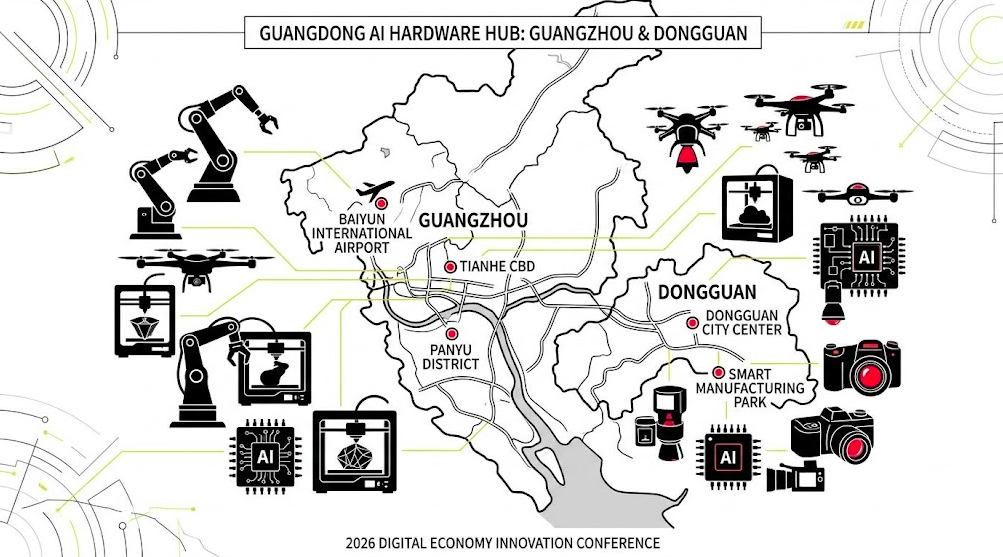
Academic experts, technology executives, and former government officials convened in Guangzhou on September 19 for the 2026 Digital Economy Innovation and Development Conference, unveiling major findings on Guangdong province's national leadership in physical artificial intelligence and hardware manufacturing.
Organized by the Jinan University School of Economics and supported by the Nanfang Daily Nanfang Industry Think Tank, the conference featured key contributions from former Shenzhen Vice Mayor and Chinese University of Hong Kong; Shenzhen governing board member Tang Jie; Alibaba Cloud Intelligence Group Guangdong General Manager Sun Yuting; China Academy of Information and Communications Technology Southern Branch Deputy Dean Zhu Jinzhou; MatataStudio Chief Executive Officer Su Rongxing; Sharge Technology Head of Research and Development Zheng Xiasong; and Jinan University Digital Economy Research Center Director Wang Xianbin.
The event was co-organized alongside the Data Elements and Real-Digital Integration Specialized Committee of the Guangdong Digital Economy Association.
A primary output of the gathering was the release of the 2026 Digital Economy Innovation and Development Report, published jointly by Jinan University and the Nanfang Industry Think Tank. The report revealed that Guangdong ranked first nationwide in 2025 with 11,806 active artificial intelligence hardware manufacturing enterprises and 324,500 total artificial intelligence hardware patents, with core sector patents accounting for 82.8 percent of the provincial total. Guangdong also secured the top national market share across seven of twelve major artificial intelligence hardware categories, capturing 58.8 percent of the nationwide market for terminal and wearable devices.
Trade metrics from the report underscored Guangdong's export strength, with the province leading national exports in six out of seven major finished hardware product types. Guangdong-based manufacturers commanded 93.3 percent of China's drone exports following a 40.8 percent year-over-year surge, alongside 83.6 percent of 3D printing equipment exports and 50.9 percent of digital imaging exports. Innovative brands including Insta360, Bambu Lab, and Shokz were cited as key drivers transforming regional industry from volume-driven production to high-margin technological innovation. Industrial clustering remains densely concentrated in the Pearl River Delta, with 39 percent of Guangdong's artificial intelligence hardware firms located within Shenzhen's Baoan, Nanshan, and Longhua districts alongside Guangzhou's Huangpu district.
Conference discussions focused on leveraging Guangdong's supply chain velocity and economic complexity to commercialize physical artificial intelligence. Tang Jie noted that specialized supply networks, such as Shenzhen's Huaqiangbei electronics market, allow small and medium enterprises to rapidly iterate artificial intelligence consumer goods.
China Academy of Information and Communications Technology Southern Branch Deputy Dean Zhu Jinzhou and Alibaba Cloud's Sun Yuting emphasized that large language models are evolving into next-generation operating systems for manufacturing, turning hardware into active cognitive vehicles. Executive leaders from MatataStudio and Sharge Technology added that complete local component supply chains in Guangdong provide a crucial speed advantage and protective moat for next-generation wearables, education tools, and robotics.

