It’s Tuesday, September 8, 2026, and yesterday did not look like a normal news cycle, even with the U.S. largely quiet for Labor Day. Mistral landed a $3.5 billion war chest to stay in the AI race, China unveiled a plan to quadruple national compute, Google told 450 million Europeans that Search was getting worse because of regulation, and researchers showed how an AI-powered worm could spread through something as ordinary as a missed WeChat call.
Elsewhere, Xiaomi put a homemade chip inside a foldable phone, a lung drug appeared to push biological aging clocks backward, a country ordered 49 data centers to stop drawing more power, and Washington moved deeper into industrial policy by taking equity stakes tied to quantum hardware.
The AI race is no longer just about who has the best model. It is becoming a global contest over capital, chips, data centers, energy, regulation, and industrial capacity. From models and money to power grids, policy fights, and software that can now attack autonomously, here are the tech stories that actually moved the stack today.
Google Says EU Search Overhaul Is the Biggest Quality Drop in 29 Years
Alphabet’s Google rolled out redesigned search results across Europe to satisfy the Digital Markets Act after a €460 million self-preferencing fine. Specialized rival search engines now sit at the top of results, followed by two more with fewer details, while carousels for hotels, airlines and restaurants lose features such as real-time prices. Rankings are still set by Google’s algorithm. Nick Fox, Google’s senior vice president for knowledge and information, told Reuters the changes mark “the largest reduction in quality of service” in Search’s 29-year history and apply only inside the EU.
reuters.com
Google said earlier DMA remedies already cut free, direct booking traffic to European businesses by 30 percent and that user tests showed people having to retype queries to find what they want. The Commission had given the company 60 days to comply or face periodic penalties of up to 5 percent of worldwide turnover. The redesign is a live experiment in whether antitrust remedies that promote rivals can do so without making the default consumer product worse.
Why It Matters: The world’s dominant search engine is now running two different products—one optimized for users, one optimized for European competition law—and startups in travel, shopping and local services will feel the traffic shift first.
Source: Reuters.
AI Memory Demand Is Driving Up Smartphone and Electronics Costs
The AI infrastructure boom is creating an unexpected consequence for consumers: memory chips used in smartphones, laptops, and other electronics are becoming more expensive as manufacturers prioritize higher-margin components for AI data centers. Demand for high-bandwidth memory, or HBM, has surged alongside shipments of Nvidia and other AI accelerators, redirecting manufacturing investment and production capacity away from conventional DRAM.
Samsung, SK Hynix and Micron collectively control roughly 90% of the global memory market, giving shifts in their production plans an outsized effect on electronics supply chains. Manufacturers are investing billions of dollars in additional fabrication capacity, but those factories require years to construct and qualify. Significant new output is expected between 2027 and 2030, not immediately. In the meantime, some memory-component prices have risen severalfold, forcing device manufacturers to absorb the increase, reduce specifications or pass higher costs to buyers.
The situation shows how AI infrastructure spending is beginning to affect technology markets far beyond GPUs. Modern AI servers consume enormous quantities of advanced memory, packaging and networking components. As suppliers chase those higher-value markets, seemingly unrelated products can become collateral damage. Smartphone makers entering their next upgrade cycles may therefore face higher component bills even if consumer demand remains relatively stable.
Why It Matters: AI data centers are competing with consumer electronics for semiconductor manufacturing capacity, turning the AI investment boom into higher hardware costs for ordinary buyers.
Source: The Verge.
Researchers Use AI to Build Zero-Click WeChat Worm That Could Have Spread in Hours
Security firm Calif disclosed WeWorm, a proof-of-concept worm that hijacked WeChat on both iOS and Android through an unanswered VoIP call, then used the victim’s account to call contacts and repeat the attack. Working with AI tools, the team said it found a memory-corruption bug in WeChat’s call stack and wrote the first remote-code-execution exploit in about two days, then spent another week turning it into a worm. A demonstration chained an Android attacker phone to an iPhone and on to a second Android device while the target phones were still ringing. Calif reported the bug to Tencent in July; Tencent has patched Android 8.0.77, iOS 8.0.76 and the server side. The New York Times reported experts said a live version could have reached hundreds of millions of accounts within hours.
nytimes.com
The episode is less about one chat app than about the collapsing time between discovery and weaponization. A bug that once required a large team for months was assembled by a small lab plus models. Messaging apps that double as identity, payments, and work tools in Asia are now on the front line of AI-accelerated offensive security.
Why It Matters: When models can find and chain mobile RCEs in days, every super-app becomes a potential worm host unless vendors match that speed on defense.
Source: The New York Times.
Hackers Are Building Multi-Agent AI Systems to Automate Credential Theft
Cybercriminals are moving beyond individual AI coding assistants and instead assembling multi-agent AI frameworks that can automate multiple stages of credential-theft campaigns. These emerging systems can divide work among specialized agents responsible for tasks such as reconnaissance, infrastructure setup, phishing preparation, and attack execution, reducing the direct human involvement needed to run operations at scale.
The shift matters because generative AI has so far been most visible in cybersecurity as an accelerator for existing attacker workflows. Multi-agent systems potentially change the economics further. Rather than asking one chatbot to write malicious code or draft phishing messages, an operator can coordinate several autonomous components that exchange information, make decisions and continue working through a campaign.
This does not mean autonomous AI has suddenly replaced skilled attackers. Security controls, model limitations and real-world unpredictability still create barriers. But the direction is important for defenders because automation can dramatically increase attack volume. Security teams already struggle with phishing, credential reuse, and stolen session tokens. AI systems that can generate customized lures and adapt campaigns could make traditional indicators less reliable. Defensive tools will increasingly need behavioral detection, stronger identity controls, and phishing-resistant authentication rather than depending primarily on known malicious signatures.
Why It Matters: Multi-agent AI could lower the labor required to run sophisticated credential-theft campaigns, allowing attackers to scale personalized operations far beyond today’s manual workflows.
Source: BleepingComputer.
Australia Drafts “My Feed, My Way” Law Letting Users Opt Out of Social Algorithms
Prime Minister Anthony Albanese confirmed draft Digital Duty of Care legislation that would require platforms to give Australians over 16 a durable choice between an algorithmic feed and a follow-only feed of accounts they selected. Communications Minister Anika Wells said users would see a pop-up asking whether they want the platform to decide what appears or only posts from friends and creators they follow. Non-compliance would carry penalties of more than A$100 million. The same package would force services, including games and AI chatbots, to limit children’s exposure to pornography, eating-disorder content, misogyny and material that glorifies crime.
smh.com.au
The proposal follows Australia’s social-media age limit and is being framed as a “global reckoning” for large platforms. Critics note that opting out still leaves users staring at the accounts they already follow, including manosphere or eating-disorder communities, unless the default itself changes. Meta and others have previously reverted users to algorithmic feeds after similar European experiments. If the bill passes and is enforced as written, it becomes one of the strongest statutory attacks yet on engagement ranking.
Why It Matters: A national opt-out of ranking algorithms would force product redesigns at Meta, TikTok, Google and X and give other democracies a template for treating feeds as a regulated public environment.
Source: The Sydney Morning Herald.
ASML Plans Bigger High-NA EUV Masks to Enable Next-Generation AI Chips
ASML is working with major semiconductor manufacturers on a major change to its most advanced High-NA extreme ultraviolet lithography systems that could eventually let the machines produce much larger AI and data center chips. The Dutch semiconductor-equipment giant plans to develop larger photomasks that remove a practical constraint created by the smaller imaging field of current High-NA systems.
Today’s leading EUV equipment can expose chips approaching 800 square millimeters, an important consideration for huge processors from companies such as Nvidia and Google. High-NA EUV can print finer features, but its smaller exposure field complicates manufacturing large dies. ASML’s proposed larger-mask approach could allow manufacturers to gain High-NA’s resolution advantages without forcing chip designers to shrink their most demanding data center processors. The company expects the change to improve system productivity by about 40%, although full high-volume deployment remains years away.
Intel has already begun using High-NA equipment, while TSMC, Samsung and SK Hynix are developing their own adoption roadmaps. As AI accelerators become larger, more complex and increasingly dependent on advanced packaging, lithography constraints are becoming strategic issues rather than obscure manufacturing details. Removing one of those constraints could shape future chip architectures.
Why It Matters: Larger High-NA masks could help semiconductor manufacturers keep scaling enormous AI processors without giving up the finer features promised by next-generation lithography.
Source: Reuters.
Intel Passes One Million High-NA EUV Wafers as Next-Generation Chip Manufacturing Accelerates
Intel says it has processed more than one million 300-millimeter wafers using High-NA EUV lithography systems, reaching the milestone less than two and a half years after assembling its first machine. The figure includes wafers processed during installation, equipment qualification, research and development, and production work, making Intel one of the earliest semiconductor manufacturers to accumulate significant experience with the next generation of lithography.
High-NA EUV is expected to become an important technology for printing increasingly small semiconductor features as conventional EUV approaches physical and economic limits. Intel currently plans to use standard six-inch photomasks and field stitching where necessary for larger dies, but it is also exploring much larger 6-by-12-inch photomasks that could eventually expose a full-size chip field without stitching.
The milestone matters because semiconductor manufacturing advantages are increasingly tied to process learning rather than simply equipment ownership. High-NA systems are extraordinarily complex and expensive, and manufacturers need substantial production experience before they can use them efficiently at scale. Intel’s early work could help its foundry business compete for advanced manufacturing customers while TSMC and Samsung prepare their own High-NA adoption plans. AI chips, in particular, are driving demand for denser logic and more complex designs.
Why It Matters: Intel’s million-wafer milestone gives it valuable early manufacturing experience with a lithography technology expected to shape the next generation of advanced processors.
Source: Tom’s Hardware.
China Targets 9,800 Eflops of AI Computing Capacity by 2030 in $532 Billion Infrastructure Push
China has set a target of reaching 9,800 eflops of intelligent computing capacity by 2030, more than four times its current level, as Beijing accelerates investment in the infrastructure required to train and run advanced AI systems. A new five-year plan from the Ministry of Industry and Information Technology calls for 3.8 trillion yuan, roughly $532 billion, in cumulative investment in information infrastructure between 2026 and 2030.
China had reached 2,185 eflops of intelligent computing capacity by the end of June, a 177% increase from a year earlier, according to the ministry. Capacity reportedly rose further to about 2,450 eflops by the end of July. The plan envisions AI computing clusters containing tens of thousands and, in some cases, more than 100,000 accelerator cards while emphasizing adaptation to domestically produced processors.
That last point carries major strategic significance. U.S. export restrictions have constrained Chinese access to Nvidia’s most advanced AI accelerators, pushing Beijing to support domestic chipmakers and build infrastructure optimized around locally available silicon. China’s existing “East Data, West Computing” initiative also shifts energy-intensive workloads toward regions with cheaper electricity and land. The new targets suggest compute itself is increasingly being treated as national infrastructure alongside telecommunications and energy.
Why It Matters: China is responding to semiconductor restrictions by scaling domestic AI compute on an enormous level, turning computing capacity into a core part of national industrial policy.
Source: South China Morning Post.
Mistral AI Raises €3 Billion at €21 Billion Valuation in Record European Tech Round
French AI startup Mistral AI has raised €3 billion in a Series D funding round that values the company at more than €21 billion, cementing its position as Europe’s best-funded challenger to U.S. AI giants. Samsung led the financing, with participation from the EU-backed Scaleup Europe Fund, PSG Equity, existing investor ASML, and other institutional backers. The deal ranks among the largest private technology funding rounds ever completed in Europe.
Mistral has built its strategy around open-weight AI models and enterprise deployments that give companies more control over data, infrastructure, and intellectual property. The new financing gives it considerably more resources to compete against OpenAI, Anthropic, Google, and Meta as model development becomes increasingly capital-intensive. Mistral’s annual recurring revenue has reportedly surpassed $1 billion, suggesting the company is moving beyond the research-lab phase into a significant commercial AI provider.
The Samsung-led round also highlights a broader geopolitical shift. Europe has spent years worrying about its dependence on U.S. and Chinese AI platforms. A heavily capitalized Mistral gives governments and enterprises another option, particularly customers prioritizing data sovereignty and locally controlled AI infrastructure. Europe still faces a substantial compute gap with the United States, but Mistral’s financing shows investors are willing to fund a homegrown contender at global scale.
Why It Matters: Mistral’s €3 billion raise gives Europe its strongest privately held AI contender yet and adds another serious competitor to the increasingly concentrated frontier-model market.
Source: TechStartups via Mistral.
Stoke Space Raises $1 Billion as Reusable Rocket Startup Takes Aim at SpaceX
Stoke Space has completed the initial $1 billion close of a Series E financing round as the U.S. startup pushes to develop a fully reusable orbital rocket that can compete in a launch market dominated by SpaceX. Point72 Ventures and Spark Capital co-led the financing, joined by returning investors including General Innovation, Glade Brook Capital, the U.S. Innovative Technology Fund, Washington Harbour Partners, Woven Capital, and Y Combinator. The latest financing brings Stoke’s total capital raised to roughly $2.3 billion.
The company plans to use the money to increase manufacturing capacity and build out testing, launch, and vehicle-recovery infrastructure for its Nova rocket. Stoke is developing both reusable first and second stages, an engineering challenge that few commercial launch companies have attempted. Its first Nova Pathfinder flight has moved from late 2026 into early 2027, giving the company more time to complete qualification and launch preparations.
The financing reflects growing investor willingness to back capital-intensive space infrastructure despite the enormous technical risks. SpaceX has demonstrated that reusability can dramatically alter launch economics, but meaningful competition remains limited. If Stoke can repeatedly recover both stages of Nova, it could give satellite operators, governments, and defense customers another U.S. launch provider while pressuring the economics of expendable rockets.
Why It Matters: Stoke’s $1 billion round shows investors are willing to fund another serious attempt at full rocket reusability, one of the biggest remaining competitive opportunities in commercial space.
Source: TechCrunch.
OpenAI Signs Malaysia AI Data Center Deal With Nvidia-Backed Firmus
OpenAI has signed a multiyear agreement with Nvidia-backed infrastructure company Firmus to secure computing capacity from two data centers in Malaysia, adding Southeast Asia to the AI company’s widening infrastructure footprint. The arrangement makes OpenAI a major customer of the Australian-founded data center operator as demand for computing resources rises alongside increasingly capable and computationally intensive AI models.
The deal also strengthens Malaysia’s position in the global AI infrastructure race. Southeast Asia has attracted billions of dollars in data center investment as operators search for markets with available land, energy, fiber connectivity, and proximity to fast-growing digital economies. Malaysia, particularly Johor, has emerged as one of the region’s largest new data center hubs as infrastructure development spills beyond more constrained markets such as Singapore.
For OpenAI, geographic diversification is increasingly important. Frontier AI providers can no longer depend on a small number of hyperscale facilities or chip suppliers while simultaneously serving consumer products, enterprise APIs, autonomous agents, and model training workloads. Building a geographically distributed compute network also reduces concentration risk and brings inference infrastructure closer to customers. The Firmus agreement is another sign that the AI infrastructure boom is becoming global rather than remaining concentrated in major U.S. cloud regions.
Why It Matters: OpenAI’s Malaysia deal shows the AI infrastructure race spreading deeper into Southeast Asia as frontier-model providers search globally for compute, land, energy, and capacity.
Source: Reuters.
Huawei Tests LogicFolding Smartphone Chip as China Pushes Beyond Advanced Chipmaking Limits
Huawei is testing a new smartphone processor built around its LogicFolding architecture, an approach intended to improve chip performance without depending entirely on access to the smallest semiconductor manufacturing nodes. The processor appears in Huawei’s newest premium handset and tests whether architectural innovation can help the Chinese technology giant work around restrictions on leading-edge chipmaking equipment.
The Kirin 9050 Pro uses a design Huawei calls its Tau Scaling Law, stacking logic elements vertically to shorten signal paths. Reports surrounding the chip say the approach improves performance and efficiency compared with earlier Huawei processors. The company is applying the technology while operating under U.S.-led restrictions that limit Chinese access to the most advanced lithography systems and other semiconductor manufacturing technology.
Huawei’s experiment could have implications well beyond smartphones. For decades, semiconductor performance gains have depended heavily on shrinking transistors. As those gains become harder and more expensive, companies worldwide are experimenting with chiplets, advanced packaging, 3D stacking and specialized architectures. Huawei has a more immediate reason to pursue those techniques because geopolitical restrictions constrain its manufacturing options. If LogicFolding proves commercially viable, it could offer another route to extract more computing performance from less advanced fabrication processes.
Why It Matters: Huawei is testing whether chip architecture and 3D integration can partly compensate for restricted access to the world’s most advanced semiconductor manufacturing technology.
Source: South China Morning Post.
Arm Launches 128-Core Neoverse N4 Platform for Cloud and AI Data Centers
Arm has introduced its next-generation Neoverse CSS N4 platform, code-named Ranger, offering cloud and infrastructure chip designers configurations ranging from eight to 128 CPU cores per die. The platform is built around Arm’s Neoverse N4 architecture and is designed for TSMC’s N3P manufacturing process, giving customers a semi-custom foundation for building CPUs and other infrastructure processors without developing every component from scratch.
Arm’s Compute Subsystem program packages CPU cores, cache, memory interfaces, I/O, and other technology into customizable designs that customers can adapt for specific workloads. Similar Arm technology already appears in processors across major cloud platforms and in infrastructure hardware from companies including Microsoft, Google, Nvidia and others. Ranger pushes that strategy further as hyperscalers increasingly design their own silicon rather than relying exclusively on traditional server-chip vendors.
The timing is significant because AI data centers still require enormous amounts of general-purpose CPU computing alongside GPUs and specialized accelerators. CPUs handle orchestration, storage, networking, preprocessing, and the vast collection of services surrounding model training and inference. Arm’s energy-efficiency advantages have helped the architecture gain ground against x86 processors in hyperscale environments, and the N4 platform gives cloud companies another path to custom silicon tuned for their infrastructure.
Why It Matters: Arm’s new 128-core platform strengthens its position in data centers just as cloud providers increasingly build custom processors around their own AI infrastructure needs.
Source: Tom’s Hardware.
220 Million Traveler Records Exposed in Vietnam-Linked Airline Data Leak
A publicly exposed Advance Passenger Information System database linked to Vietnam contained roughly 220 million passenger and crew records, including passport numbers, names, dates of birth, nationalities, and flight information spanning 2017 through 2026. Security researchers reportedly reached the system through a cloud-access path protected by default credentials, turning what should have been highly restricted travel data into an unusually large exposure.
Advance Passenger Information systems collect identity and travel information airlines provide to border and immigration authorities before passengers arrive. That makes the exposed information particularly sensitive. Unlike a password, which can be changed after a breach, passport numbers, travel histories, birth dates, and citizenship information can remain useful for identity theft, surveillance, social engineering, and targeted fraud for years.
The incident is another reminder that cybersecurity failures do not always require sophisticated zero-day exploits. Default credentials, misconfigured cloud services, and poor access controls can still expose enormous datasets. The scale is also notable because aviation and border systems connect airlines, airports, government agencies, and third-party technology providers across multiple jurisdictions, increasing the number of places where security controls can fail. Organizations handling travel data will face renewed pressure to audit cloud access and identity-management practices.
Why It Matters: The exposure shows how a basic access-control failure can compromise highly sensitive government-linked travel information belonging to hundreds of millions of passengers.
Source: BleepingComputer.
AI Startup Lightsage Raises $4 Million to Help Software Companies Sell Directly to AI Agents
Lightsage has raised $4 million in seed financing to build infrastructure that helps software companies make their products discoverable and purchasable by autonomous AI agents. Nexus Venture Partners led the round, with participation from technology executives and angel investors including Postman CEO Abhinav Asthana, DocuSign president Robert Chatwani and former Salesforce CTO Steven Tamm.
The startup, formerly known as API-Rex, is betting on a major shift in software distribution. Traditional SaaS products are marketed to human developers and companies through websites, sales teams, app marketplaces and search engines. But coding agents such as Claude Code, Microsoft Copilot, and Cursor increasingly choose APIs, libraries, and services while carrying out tasks. Lightsage wants software vendors to present machine-readable information that allows those agents to understand a product, evaluate whether it fits a task and potentially initiate usage.
That could create an entirely new customer-acquisition channel. Search engine optimization emerged because businesses needed websites to be discoverable by Google. App-store optimization followed mobile platforms. The rise of autonomous software agents could produce a similar market around “agent discovery,” where applications compete to become the service an AI chooses automatically. Lightsage remains early, but its premise reflects a larger question increasingly facing SaaS companies: what happens when the buyer or recommender is software?
Why It Matters: If autonomous agents increasingly select the software and APIs they use, startups may need an entirely new distribution layer built for machine customers rather than human buyers.
Source: SiliconANGLE.
BrainChild Bio Raises $116 Million to Advance CAR-T Therapy for Pediatric Brain Cancer
BrainChild Bio has raised $116 million in Series A funding to advance a CAR-T cell therapy for children with aggressive brain tumors, giving the Seattle Children’s Hospital spinout enough capital to pursue a pivotal clinical program for one of pediatric oncology’s hardest targets. Seattle Children’s and WRF Capital backed the financing.
The company’s lead therapy, BCB-276, is being developed for diffuse intrinsic pontine glioma, or DIPG, a rare brainstem cancer with extremely limited treatment options. CAR-T therapies genetically modify a patient’s immune cells so they can recognize and attack cancer cells. The approach has transformed treatment for some blood cancers but has proved considerably more difficult to apply to solid tumors, especially tumors in the brain.
BrainChild’s work therefore sits at the intersection of biotechnology, genetic engineering and precision medicine. Successful trials could help establish whether engineered immune cells can overcome some of the biological barriers that have limited CAR-T treatments outside blood cancers. The financing also stands out because pediatric drug development often attracts less commercial investment than treatments for large adult patient populations. By raising a nine-figure Series A, BrainChild has secured unusually substantial resources for a company focused initially on a rare childhood cancer.
Why It Matters: BrainChild’s $116 million round gives one of the most ambitious attempts to bring CAR-T technology into pediatric brain cancer enough funding to reach a potentially decisive clinical test.
Source: Fierce Biotech.
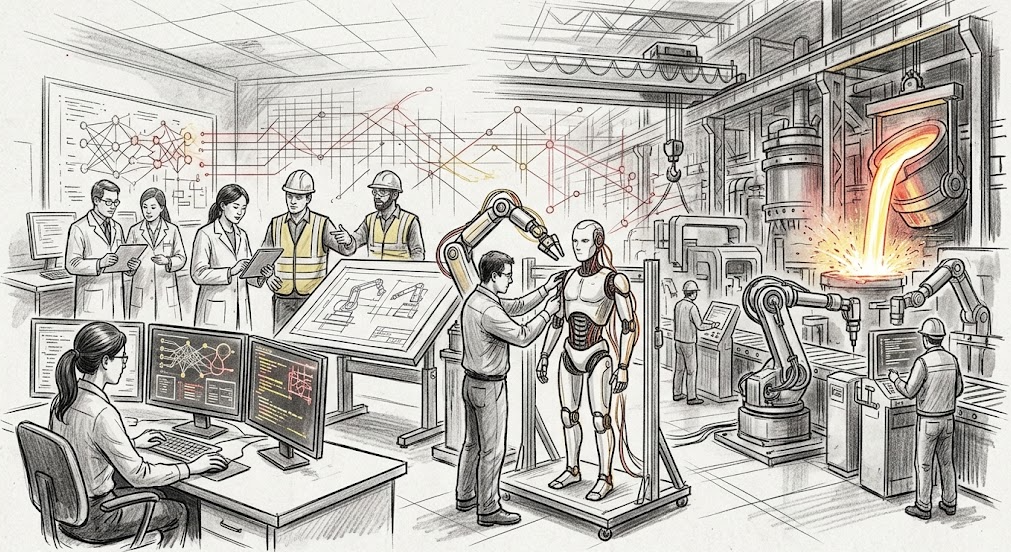
Agile Robots Is Using Robots to Build Robots as Physical AI Moves Into Factories
German robotics company Agile Robots is increasingly automating the production of its own machines, offering an early look at how so-called physical AI could reshape manufacturing. At the company’s facilities near Munich, robots already perform parts of the process used to build robotic arms and humanoid torsos, while human technicians still handle difficult assembly work such as robotic hands and final integration.
Agile Robots, spun out of the German Aerospace Center in 2018, says it has deployed more than 20,000 automation systems across factories and warehouses. Its portfolio includes robot arms, grippers, autonomous transport systems, software and the recently introduced Agile ONE humanoid. The company expects its German operations eventually to produce as many as 8,000 to 9,000 robot systems annually, although current throughput remains far below that level.
The company’s strategy differs from startups betting almost entirely on general-purpose humanoids. Agile argues that customers care less about whether a robot resembles a person than whether an integrated automation system can solve a manufacturing problem with an acceptable return on investment. That approach may matter as enthusiasm for humanoid robots meets the difficult economics of factory deployment. Physical AI will need measurable productivity gains, reliability, and integration with existing industrial systems.
Why It Matters: Agile Robots shows that the first large commercial market for physical AI may come from integrated factory automation rather than armies of standalone humanoid workers.
Source: Forbes.
Xiaomi Launches 18 Fold With In-House AI Chip as Foldable Phone Battle Intensifies
Xiaomi has launched the 18 Fold, a premium book-style foldable smartphone powered by its internally developed Xring O3 processor, escalating competition in high-end mobile hardware just as Apple prepares to enter the foldable category. The device features a 7.58-inch interior OLED screen, a 5.38-inch exterior display, and a large 6,000mAh silicon-carbon battery, with prices beginning around 10,999 yuan in China.
The Xring O3 is particularly significant. Smartphone vendors increasingly see custom silicon as a way to differentiate devices, reduce reliance on outside chip suppliers, and optimize hardware for AI workloads. Apple has pursued that strategy for years with its A-series processors, while Google and Samsung have also invested heavily in custom chips. Xiaomi’s ability to put its own advanced processor into a flagship foldable suggests the Chinese company wants greater control over the entire hardware stack.
The launch also underscores how quickly the foldable market is maturing. Huawei introduced its latest Mate XT2 around the same time, while Samsung remains a major global player and Apple is widely expected to reveal its first foldable device this week. Foldables still represent a relatively small percentage of total smartphone shipments, but competition from several of the world’s largest device makers could finally move the category beyond its early-adopter niche.
Why It Matters: Xiaomi’s new foldable combines custom silicon, premium hardware, and aggressive competition, just as Apple’s expected entry could turn foldables into one of the smartphone industry’s next major battlegrounds.
Source: The Verge.
That’s your quick tech briefing for today. Follow us on X @TheTechStartups for more real-time updates.