China’s state-backed artificial intelligence strategy is expanding through direct equity investments in frontier model developers alongside coordinated municipal infrastructure pushes.
Beijing Kling Technology Co., Ltd., the operator behind short-video giant Kuaishou's generative video model Kling AI, completed a new equity funding round featuring the National Artificial Intelligence Industry Investment Fund and Charoen Pokphand Group's investment unit, CP Robotics.
The state-backed National AI Fund injected 1.4 billion yuan (approximately $197 million) in cash for a 1.14 percent stake, while CP Robotics contributed $19.29 million for a 0.11 percent equity share. The capital injection establishes a post-money valuation for Kling AI of approximately $18 billion, with parent company Kuaishou retaining an indirect controlling stake of roughly 68.33 percent.
The National AI Fund, established in January 2025 with 60.06 billion yuan in total capital commitments, counts China's Ministry of Finance as its largest ultimate shareholder. Under the terms of the investment, the investors hold repurchase rights requiring Kling AI to complete an initial public offering by October 30, 2031.
Kling AI reported more than 850 million yuan in revenue for the first half of 2026, representing a year-over-year increase exceeding 200 percent. As of June 2026, the video generation platform surpassed 100 million global users across 224 countries and regions, serving nearly 50,000 enterprise clients.
Concurrently, regional industrial hubs are enacting policies to build out foundational compute networks and domain-specific applications. In Jiangsu province, municipal leadership in Wuxi convened on Wednesday to oversee execution of the city's primary political directive to establish a national "AI+" benchmark city.
Wuxi Party Secretary Du Xiaogang instructed departments to accelerate the construction of specialized high-quality datasets and industry-specific vertical models for advanced manufacturing and municipal administration. The initiative mandates a unified computing supply system combining general, intelligent, and supercomputing capabilities, while launching specific programs to develop a token-based digital economy.
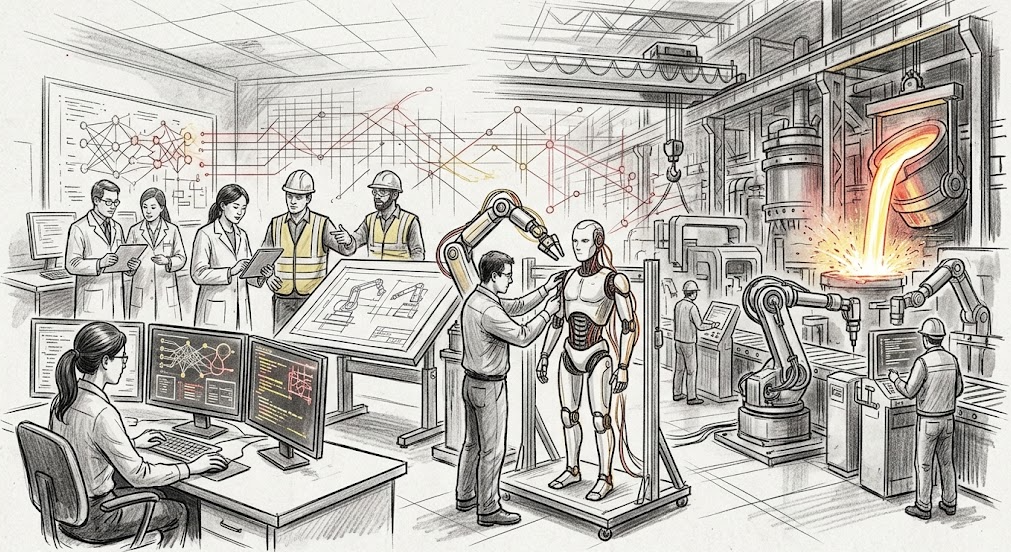
The local roadmap calls for integrating AI into research for integrated circuits and biomedicine, lowering production costs in quality testing, and scaling hardware deployments including humanoid robots and smart eyewear across urban logistics and public services.