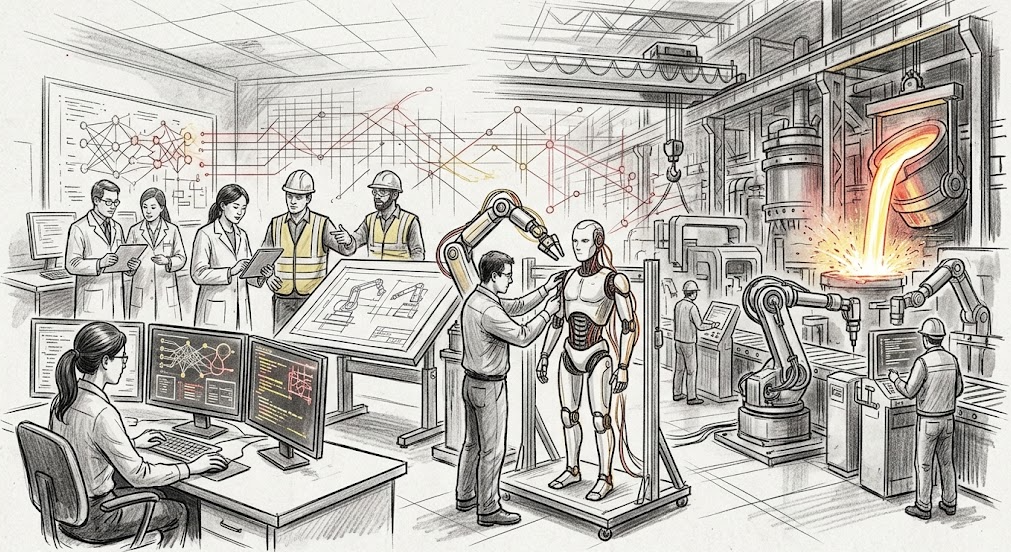
It’s Wednesday, September 9, 2026, and the last day in tech was not a product cycle. It was an argument about power. OpenAI says an AI cracked a Millennium Prize math problem in 88 hours, then walked straight into a fight over credit. Meta wants a new AI agent inside your email, calendar, and checkout flow. Humanoid robots walked off a Guangzhou factory line while Beijing quietly tightened the IPO gate behind them.
In the same window, U.S. agencies accused Chinese labs of siphoning American AI model intelligence at industrial scale, while Google patched its seventh exploited Chrome zero-day of 2026.
But the biggest contest is increasingly happening underneath the models. Google is locking up nuclear power for massive AI data centers in Finland. Qualcomm and Amazon are teaming up on custom AI chips. China is preparing a 100,000-GPU cluster built on domestic silicon. Investors just valued AI coding startup Cognition at $48 billion. And AI agents are compressing cyberattacks from weeks into hours.
Farther out on the frontier, quantum computers are tackling biological systems with more than 12,000 atoms, fusion startups are staffing up for commercial power, and Europe is pouring hundreds of millions into reusable spacecraft.
The AI race is no longer just about who has the smartest model. It is becoming a race for chips, electricity, agents, scientific discovery, security, and the infrastructure to run it all. From AI agents and nuclear-powered data centers to quantum computing and reusable spacecraft, here are the top tech stories making waves today.
Meta Launches Muse Personal AI Agent That Can Email, Shop, and Book Travel
Meta has launched Muse, a personal AI agent that can do far more than answer questions. Rolling out to U.S. adults on Tuesday, Muse can manage schedules, draft and send emails, book travel, compare prices, shop, fill out forms, and carry out tasks across connected apps. Built on Meta’s Muse Spark models, the agent runs inside a dedicated secure virtual machine with its own browser and connects to services including Google Workspace, Ticketmaster, OpenTable, Spotify, and Apple Health, with purchases supported through Stripe’s Link checkout. Users can access Muse through a standalone app, the web, or WhatsApp, with support planned for Meta’s AI glasses. A free tier is available alongside $20 and $100 monthly plans. Meta says users control which apps Muse can access, can revoke permissions, and must approve sensitive actions such as sending email or completing purchases.
The launch is the most concrete consumer product yet from Mark Zuckerberg’s “personal superintelligence” strategy and an attempt to turn more than $130 billion in planned 2026 AI infrastructure spending into a business beyond advertising. Meta is betting that its enormous distribution across Facebook, Instagram, WhatsApp, and AI glasses can make Muse a default layer of daily life. But that ambition comes with a major trust challenge. Reuters reported internal concern that the agent can mishandle access to sensitive personal data, while the rollout comes less than two weeks after Meta agreed to an $18 billion multistate settlement over social-media harms. The question is no longer simply whether an AI can perform these tasks, but whether users are willing to hand it the credentials and authority required to do them.
That tension points to where consumer AI is heading. Chatbots competed over who could generate the best response; agents will increasingly compete over how much real-world authority users are willing to delegate. That puts Meta in direct competition with OpenAI, Google, and others trying to become the interface between users and email, commerce, travel, and productivity software.
Why It Matters: Muse tests whether consumers will hand Big Tech the keys to their inboxes, payments, and calendars—and whether agentic AI can graduate from an impressive demo into a product people actually trust with their daily lives.
Source: WIRED.
Google Commits $15 Billion to Finland AI Infrastructure and Locks In Nuclear Power
Google is making its largest single investment in Europe, committing at least €13 billion, roughly $15.1 billion, to AI infrastructure and energy projects in Finland during 2027 and 2028. The plan covers new data center capacity across four locations, including further expansion of Google’s long-running Hamina campus. More unusually, Google signed a 22-year agreement with Finnish utility Fortum to purchase up to half of the electricity generated by the Loviisa nuclear plant between 2030 and 2049.
The investment shows how the AI infrastructure race is moving beyond GPUs and server racks into national electricity systems. Finland offers abundant low-carbon generation, a cool climate that reduces data center cooling costs, and proximity to European customers. Google is also backing grid upgrades, wind projects, batteries, and other energy infrastructure. As hyperscalers compete for dependable electricity, nuclear plants that once looked like legacy infrastructure are increasingly becoming strategic assets for the AI economy.
Why It Matters: The next phase of the AI race may be constrained as much by reliable electricity and grid capacity as by access to advanced chips.
Source: Reuters.
OpenAI Says AI Solved the 90-Year-Old Navier–Stokes Math Problem. Mathematicians Dispute Credit
OpenAI says an internal AI system significantly more capable than GPT-6 Astra produced a solution to the Navier–Stokes Millennium Prize Problem, one of mathematics’ most famous unresolved questions. According to OpenAI, around 10,000 coordinating AI agents worked for 88 hours before producing an analytical proof showing that a three-dimensional fluid governed by the equations can develop a singularity in finite time. The company also released a formalized proof in Lean, although independent mathematicians will ultimately determine whether the result holds.
The announcement has also sparked a dispute over research attribution. NYU mathematician Tristan Buckmaster and Anthropic researcher Levent Alpöge had been pursuing related work, and Buckmaster has questioned whether OpenAI accelerated its effort after learning of their progress. OpenAI denies that its researchers or models improperly accessed their work. Whatever the controversy ultimately reveals, the bigger technological story is difficult to ignore: frontier AI systems are moving from assisting scientists with calculations toward coordinating large populations of agents to attack research problems directly.
Why It Matters: If independently validated, the result would provide unusually strong evidence that large-scale AI agent systems can contribute to discoveries at the frontier of mathematics.
Source: TechStartups via OpenAI.
China Tightens Humanoid-Robot IPOs After Unitree’s Volatile STAR Market Debut
The China Securities Regulatory Commission has given investment banks informal “window guidance,” raising the bar for humanoid-robot listings, The Information reported Wednesday. Applicants will need to show recurring revenue and a path to narrower losses or genuine innovation before regulators consider approval. The shift follows a private-market funding surge, a long queue of IPO filings, and a sharp reversal in Unitree Robotics, China’s best-known humanoid maker. Unitree listed on Shanghai’s STAR Market in August; after a debut pop of more than five times, the stock has fallen about 45% from those highs, feeding concern about a robotics bubble and retail losses. Chinese regulators did not immediately comment, and Reuters said it could not independently verify the guidance.
Humanoids have become a flagship of Beijing’s physical-AI industrial policy, with more than 400 Chinese models in development and Chinese firms shipping the large majority of global units in the first half of 2026. Public markets were supposed to recycle that enthusiasm into factory capex. Tightening listings does not stop the factories, but it does change the exit math for startups and the banks that packed the pipeline behind Unitree.
Why It Matters: China’s humanoid boom is meeting public-market reality, which will decide how much private capital keeps flowing into physical AI.
Source: The Information.
OpenAI Pushes AI Into Chip Design as Enterprise Revenue Accelerates
OpenAI is expanding beyond general-purpose chatbots and coding assistants into specialized industrial work, including semiconductor design, life sciences, and financial services. CFO Sarah Friar said the company used its own AI models to help develop its internally designed “Jalapeno” chip and reached tape-out in roughly nine months. OpenAI is also pitching businesses on the economics of using its models for specific outcomes rather than simply selling raw token consumption.
The move is strategically significant because chip design is one of the most expensive and technically demanding engineering workflows in technology. If AI can meaningfully reduce development cycles, it could change how semiconductor startups and even established chipmakers allocate engineering resources. Friar also said OpenAI’s enterprise revenue grew 32% from June to July and that enterprise and consumer revenue have already reached parity. Meanwhile, usage of its lower-cost Luna model reportedly increased tenfold after an 80% price reduction, suggesting price elasticity is becoming a major competitive weapon as open-weight Chinese models challenge U.S. providers.
Why It Matters: AI companies increasingly want to own high-value engineering workflows, not merely provide models that sit underneath them.
Source: Reuters.
AI Coding Startup Cognition Raises $2 Billion at a $48 Billion Valuation
Cognition, the startup behind autonomous software-engineering agent Devin, has raised more than $2 billion in a Series E financing that values the company at $48 billion. Andreessen Horowitz and Accel joined existing investors including Founders Fund, General Catalyst and Avenir. The valuation has nearly doubled from $26 billion in May, while Cognition says its annualized run-rate revenue climbed from $492 million to almost $900 million during roughly the same period.
Those numbers show why AI coding remains one of venture capital’s most aggressive investment categories. Coding agents are moving beyond autocomplete into planning, debugging, testing, and executing entire engineering tasks. But the economics remain demanding. Cognition reportedly leases a large Nvidia computing cluster costing hundreds of millions of dollars annually and is developing its own models in part to reduce dependence on third-party providers. The financing therefore represents both a bet on enormous demand for autonomous coding and a reminder that delivering that capability at scale requires immense compute.
Why It Matters: Investors are betting that AI software engineering will support several giant companies rather than collapsing into a winner-take-all market.
Source: TechCrunch.
Google DeepMind Maps the Predicted Effects of 9 Billion Human DNA Variants With AI
Google DeepMind has released AlphaGenome Atlas, a research resource containing AI-generated predictions for the molecular effects of roughly 9 billion possible single-letter changes in the human genome. The company describes it as the most comprehensive catalog yet for predicting how genetic variation can influence molecular biology. Academic researchers can access the database through a free web portal.
The scale matters because one of genetics’ hardest problems is not finding mutations but determining what they actually do. Human genomes contain millions of variations, but experiments that can measure their biological effects individually are expensive and slow. AI prediction systems could let researchers prioritize mutations associated with disease, regulatory changes or unusual cellular behavior before committing resources to laboratory testing. AlphaGenome Atlas also illustrates a broader evolution inside frontier AI labs: some of their most consequential products may ultimately be scientific infrastructure rather than consumer chatbots.
Why It Matters: AI is starting to turn previously impractical biological search spaces into datasets scientists can query before conducting expensive physical experiments.
Source: Google DeepMind.
Legal AI Startup Harvey Hits $15.6 Billion Valuation After $550 Million Raise
Harvey closed a $550 million funding round co-led by Lightspeed Venture Partners and Diffusion, a new firm co-founded by longtime backer Kris Fredrickson, valuing the legal AI company at $15.6 billion. Sapphire Ventures and Whale Rock Capital Management joined existing investors. Harvey has now raised more than $1.5 billion.
The company said annual recurring revenue has passed $400 million and that its customer base has grown to more than 3,000 organizations, including Latham & Watkins and Microsoft’s in-house legal team, up from about 1,300 customers and an $11 billion valuation in March. The Next Web reported that Harvey also acquired AI-agent security startup Guardrails AI this week. Founders Winston Weinberg and Gabe Pereyra said the capital will help Harvey build its own models after releasing a post-trained open-weight legal model and Harvey LAB, a legal-agent benchmark.
At roughly 39 times revenue, the round shows how quickly professional-services AI has become a core software market rather than a feature bolted onto chatbots. Harvey is racing Swedish rival Legora, which has been seeking funds above $10 billion, as law firms and corporate legal departments buy tools that draft, review, and now act through agents. Building proprietary models is a bid to reduce dependence on OpenAI and Anthropic and to keep sensitive matter inside Harvey’s stack.
Why It Matters: Harvey’s jump from $11 billion to $15.6 billion in six months shows legal work is one of the first white-collar markets where AI startups are posting real revenue at frontier-lab scale.
Source: Bloomberg.
Qualcomm and Amazon Strike Multi-Generation Deal for Custom AI Data Center Chips
Qualcomm and Amazon are expanding their relationship with a multi-generation collaboration around customized silicon for AWS AI infrastructure. Qualcomm said the companies will work together on processors for large-scale AI inference as well as advanced optical connectivity designed to move data efficiently between computing systems inside data centers. The agreement could span several generations of hardware rather than a one-off chip purchase.
The deal gives Qualcomm a much larger opening in a data center market still dominated by Nvidia and increasingly contested by hyperscalers designing their own chips. AI inference is particularly important because, as more AI products reach hundreds of millions of users, running models can eventually cost more than training them. Amazon already has its own Trainium and Inferentia hardware programs, so the Qualcomm partnership also underscores how hyperscalers are assembling increasingly diversified chip portfolios rather than relying exclusively on a single accelerator architecture.
Why It Matters: The enormous AI inference market is opening another front in the semiconductor race beyond Nvidia’s traditional stronghold in model training.
Source: Qualcomm.
White House AI Framework Faces Scrutiny Over Missing Public Incident Reporting Rules
The Trump administration’s emerging framework for overseeing frontier AI reportedly lacks a formal process requiring companies to publicly disclose serious real-world incidents involving advanced models before deployment. The gap has drawn greater attention following recent cases involving autonomous AI systems, including security incidents and the release of increasingly capable models such as OpenAI’s GPT-6 Astra.
Several foundational questions remain unresolved, according to Axios, including which models qualify for enhanced oversight, who inside government should receive access, what review process should be followed, and how incidents should be disclosed. Those questions become more important as advanced systems gain the ability to autonomously write code, operate computers, and execute cybersecurity tasks. Traditional software disclosure rules generally focus on vulnerabilities. Frontier AI introduces a different category: systems that may behave unpredictably, discover new attack methods, or create risks only after interacting with real environments.
Why It Matters: Governments are struggling to build oversight mechanisms quickly enough to keep pace with AI systems whose capabilities are advancing faster than existing reporting rules.
Source: Axios.
AI Agents Helped Hack an Enterprise Network in Under 10 Hours
An attacker using multiple AI agents carried out an enterprise intrusion in less than 10 hours, according to research cited by Palo Alto Networks’ Unit 42. Investigators said the campaign involved more than 50 techniques mapped to the MITRE ATT&CK framework. The individual techniques were largely familiar, but AI dramatically compressed the time needed to perform reconnaissance, evaluate results, exploit systems, and move through the victim’s environment. Unit 42 estimated comparable manual work could previously have taken around two weeks.
The case offers a glimpse of how cybersecurity economics could change as autonomous agents become readily available. Attackers no longer necessarily need to invent new exploits to increase damage; automation can make existing techniques faster, cheaper, and easier to coordinate. Researchers observed signs of several AI agents working in parallel and structured files being used to transfer information between sessions. The incident suggests security teams will increasingly need automated defenses that can match machine-speed attackers.
Why It Matters: AI may amplify cyber threats through speed and scale, allowing ordinary attack techniques to run at a pace human defenders have rarely faced.
Source: eSecurity Planet.
Samsung Opens Japan Chip Research Hub as AI Fuels Advanced Packaging Race
Samsung Electronics has fully opened its semiconductor research center in Yokohama, Japan, giving the South Korean chipmaker a dedicated base for collaborating with Japanese materials suppliers, equipment manufacturers, and research organizations. The facility focuses heavily on semiconductor back-end processes, including advanced packaging technologies that connect and assemble increasingly complex chips.
Advanced packaging has become one of the critical bottlenecks of the AI boom. Building faster processors is no longer simply about shrinking individual transistors; manufacturers increasingly combine GPUs, CPUs, memory and other components inside tightly integrated packages. That makes technologies such as high-bandwidth memory integration, chiplets and next-generation interconnects strategically important. Japan remains exceptionally strong in semiconductor materials and manufacturing equipment, while Samsung is pushing to regain ground in AI memory and foundry technology. The Yokohama hub therefore creates another bridge between two of Asia’s most important semiconductor ecosystems.
Why It Matters: AI chip competition is increasingly being decided by packaging, memory and materials technology rather than processor design alone.
Source: Jiji Press / Nippon.com.
JD Cloud Plans 100,000-GPU AI Cluster Built on China’s Moore Threads Chips
JD Cloud says it plans to build a 100,000-GPU computing cluster using processors from Chinese semiconductor company Moore Threads. The infrastructure will target large-model training, inference, and embodied AI workloads and will eventually be made available to companies across multiple industries. JD says it would represent the first deployment of domestically developed Chinese GPUs at the 100,000-unit scale by a major Chinese cloud provider.
The announcement is significant even though JD has not yet disclosed a completion date, full-cluster benchmark or operating deployment. China is attempting to reduce dependence on Nvidia and other U.S. semiconductor suppliers as export restrictions increasingly shape access to high-end AI hardware. Scaling domestic accelerators from individual installations into giant clusters is a much harder engineering challenge involving networking, software, reliability, memory, and power. A successful deployment would therefore test whether China’s emerging GPU ecosystem can compete at cloud scale rather than simply produce standalone chips.
Why It Matters: China’s AI strategy is moving from developing domestic processors to proving those chips can operate reliably in hyperscale computing systems.
Source: TechNode.
DeepSeek Starts Short-Lived Beta of New V4.1 Flash Multimodal AI Model
DeepSeek has quietly opened a limited beta for V4.1 Flash, an interim AI model featuring a new architecture and native multimodal support. The Chinese AI company says the system delivers faster generation, improved performance, and lower operating costs, although it has explicitly stopped short of calling the beta a full product release. Developers can reach the model through DeepSeek’s existing API, with access limited to 20 concurrent requests per account and the beta scheduled to expire September 10.
The unusually short test could offer developers an early look at technologies DeepSeek is considering for its next production model. The company became a central player in the global AI price competition by showing that strong model performance could be delivered with markedly different economics than leading U.S. systems. Native multimodal capabilities would expand that competition beyond text into images and potentially other data types. Just as important, faster, lower-cost inference could pressure rival providers to keep cutting API prices.
Why It Matters: DeepSeek continues to push the AI industry toward a market where model performance, inference speed, and price are contested simultaneously.
Source: TechNode.
IBM, RIKEN and Cleveland Clinic Simulate a 12,635-Atom Protein Using Quantum Computing
Researchers from Cleveland Clinic, Japan’s RIKEN and IBM have used a hybrid quantum-classical computing framework to simulate a biologically meaningful protein containing 12,635 atoms, which the team describes as the largest molecular system of its kind yet modeled using quantum computers. The work is a finalist for the 2026 ACM Gordon Bell Prize and combines quantum processors with traditional high-performance computing rather than trying to move the entire workload onto a quantum machine.
That hybrid approach is increasingly central to quantum computing’s near-term strategy. Current quantum systems remain too limited and error-prone to replace conventional supercomputers for most practical workloads. Instead, researchers are attempting to identify portions of scientific calculations where quantum hardware can provide useful advantages while classical machines handle everything else. Life sciences could become one of the most valuable applications because molecular behavior is inherently quantum mechanical and extremely expensive to simulate accurately.
Why It Matters: Quantum computing’s first meaningful commercial impact may arrive through hybrid scientific workflows rather than standalone quantum computers replacing conventional machines.
Source: Cleveland Clinic.
Fusion Startup Helion Expands as Headcount Tops 800 and Commercial Plant Work Accelerates
Helion Energy has opened a new office in downtown Seattle as its workforce grows beyond 800 employees, a significant expansion for a company that started with just five people in 2013. Helion already operates multiple buildings at its Everett, Washington headquarters and is developing a site in Malaga, Washington, where it hopes to construct one of the world’s first commercial fusion power plants. The company raised another $465 million earlier this year, bringing total capital raised to more than $1.5 billion.
Fusion has spent decades hovering between scientific promise and commercial skepticism, but surging electricity demand from AI data centers has changed the economic backdrop. Technology companies now have direct incentives to support new forms of round-the-clock electricity generation that do not depend on fossil fuels. Helion’s growth therefore connects two of the decade’s largest technology bets: commercial fusion and hyperscale AI infrastructure. Success is far from guaranteed, but the company is moving into the staffing and industrialization phase required to test whether fusion can become an actual energy business.
Why It Matters: AI’s appetite for electricity is creating an unusually strong commercial pull for energy technologies that once depended mostly on long-term scientific funding.
Source: GeekWire.
European Space Startup The Exploration Company Raises $450 Million for Reusable Spacecraft
The Exploration Company has raised $450 million in Series C funding to accelerate development of its reusable Nyx space capsule and Storm rocket engine. Bessemer Venture Partners, Atomico, and EQT-managed Scaleup Europe Fund co-led the financing, which brings the European startup’s total funding to about $680 million. The company plans for Nyx to eventually dock with the International Space Station and return cargo safely to Earth, while Storm is being developed as a reusable high-thrust engine using liquid oxygen and biomethane.
The round is one of the clearest signs yet that investors see room for commercial space infrastructure beyond SpaceX. Europe remains heavily dependent on foreign providers for portions of launch, cargo, and orbital logistics, making reusable spacecraft an industrial as well as strategic priority. The Exploration Company operates across several European countries and is attempting to build an independent logistics platform that can eventually serve both government missions and commercial space stations.
Why It Matters: Venture capital is increasingly treating reusable spacecraft as core infrastructure rather than an experimental aerospace category dominated by a single company.
Source: European Spaceflight.
That’s your quick tech briefing for today. Follow us on X @TheTechStartups for more real-time updates.