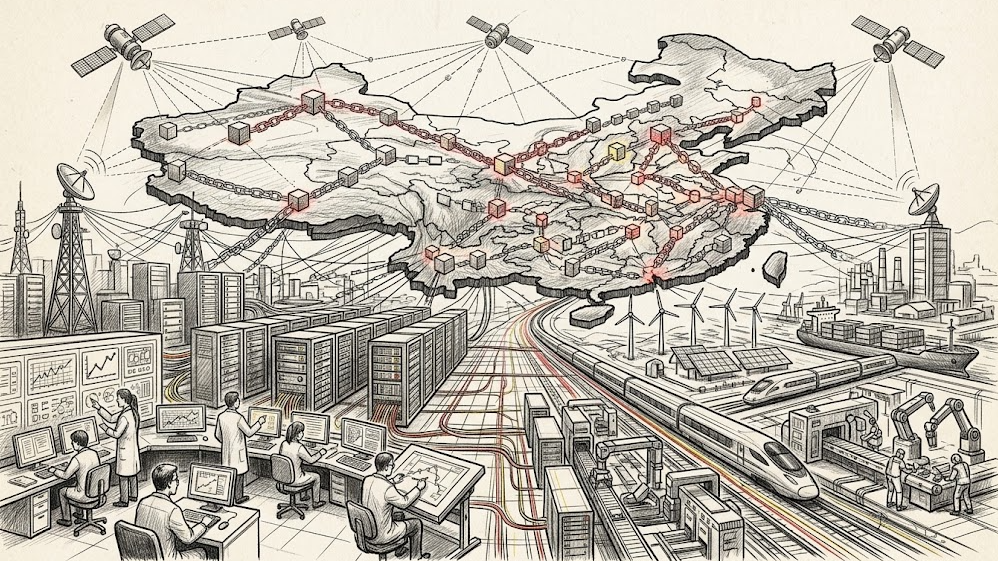
Chinese AI models, factories and components are deeply embedded in America’s technology industry, complicating Washington’s efforts to treat the race for AI dominance as a winner-take-all contest

The US and China are competing for AI dominance, but their technology industries remain deeply interconnected. From cheaper Chinese AI models to data-centre equipment and robotics components, here’s why American tech companies still depend on China.

- US firms increasingly rely on cheaper Chinese AI models.
- China dominates the manufacturing of physical AI products.
- Data centers and hardware still heavily depend on China.



The United States and China are often described as locked in a race for dominance in artificial intelligence. But behind the political rivalry lies a more complicated reality: American companies continue to depend heavily on Chinese AI models, manufacturing and technology components.
Moonshot AI illustrates the contradiction. US security agencies have accused the Beijing-based company and five other Chinese AI firms of training their systems on American models without authorisation. Yet Moonshot’s Kimi K3 is also being used by US companies as a cheaper alternative to Silicon Valley AI products.
The connection goes much further. American data centres contain Chinese-made equipment, while AI-enabled consumer products, including Meta smart glasses, are manufactured in China.
“We’re so deeply intertwined,” Kyle Chan, an AI specialist at the Brookings Institution, told The Washington Post. “There’s a lot of actual dependency.”
Chinese AI models offer a cheaper alternative
One reason American companies are turning to Chinese AI is cost.
“Open weight” models produced by companies including Moonshot, DeepSeek and Alibaba can be customised by users and are considerably cheaper than closed models from US companies such as OpenAI and Anthropic.
American models remain more advanced, but companies including DoorDash and Airbnb have found Chinese alternatives capable enough for many routine applications. When the Trump administration considered restrictions on Chinese AI models in July, nearly 300 US companies opposed the move.
US laboratories still have an estimated lead of several months in the pursuit of artificial general intelligence, or AGI, which the report describes as a level of cognitive ability exceeding human capabilities.
China, however, is pursuing a somewhat different strategy.
China is putting AI into factories and everyday products
While leading American companies are focused heavily on developing increasingly sophisticated AI models, many Chinese companies are concentrating on putting existing technology to work across the economy.
That already includes hotel robots, AI home assistants, AI-generated videos and surveillance systems. China wants to take the approach much further. Its “AI Plus” initiative calls for extensive integration of AI across the economy and society, with six priority sectors expected to reach 90 percent adoption of intelligent agents and terminals by 2030.
Tashan Technology in Beijing offers one example. It is developing tactile processing chips that help robots determine how firmly they should grip different objects. Its robots are being trained for jobs ranging from cleaning kitchen spills to handing hotel guests their room-service orders.
US leads in computing power, China in manufacturing
Chinese AI companies operate with major disadvantages. The six largest generate only about 10 percent of the combined annual revenue of OpenAI and Anthropic, according to Epoch AI.
US export restrictions on advanced chips have also created a substantial computing gap. American companies have a 10-to-one advantage in the processing power available to develop, test and run AI models, according to an Institute for Progress report cited in the article.
China’s advantage is manufacturing.
Its enormous electronics supply chain allows companies to prototype, test and improve physical AI products quickly and cheaply. The difference is particularly important in robotics, where manufacturers need everything from sensors and motion controllers to specialised electronic components.
Morgan Stanley estimates that the materials for Tesla's Optimus 2 humanoid robot would cost about $46,000 using Chinese suppliers. A non-Chinese supply chain would raise that to about $132,000.
America’s AI infrastructure still contains Chinese parts
Washington has spent years trying to reduce US dependence on China for critical products, but the AI boom shows how difficult complete separation could be.
US hyperscale data-centre operators imported roughly $45 billion in AI-related goods from China last year, including computer hardware, power equipment and cooling and fire-safety systems. That was down from about $55 billion two years earlier as Taiwan and Vietnam took a larger share.
Some relationships remain particularly striking. Nearly 60 percent of Chinese optical-transceiver maker Zhongji InnoLight's business comes from American customers including Alphabet, Amazon and Nvidia. Yet the Pentagon added the company to its list of suppliers linked to the Chinese military in June.
The result is an uncomfortable dilemma for Washington. China is simultaneously America's biggest AI competitor, a national-security concern and an important supplier to the very technology industry the US hopes will keep it ahead.
The race for AI dominance, in other words, is being fought by two economies whose technology industries remain far more dependent on each other than the rhetoric of rivalry suggests.