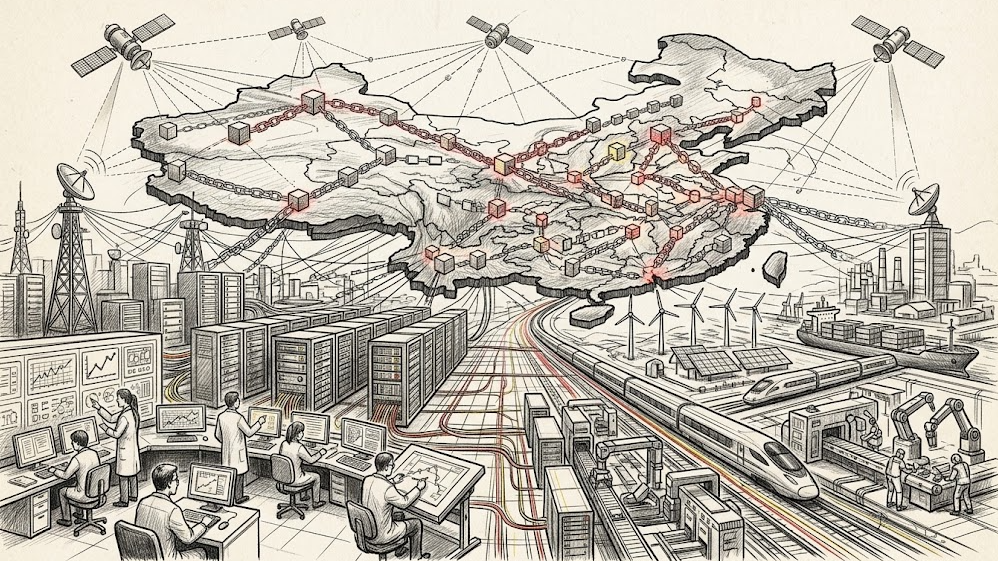
Workarounding: Tech Middle Power Cooperation in a Turbulent World
Edited by Maximilian Mayer, Gedaliah Afterman, Narayanappa Janardhan & Laura Mahrenbach
Published by
Palgrave Macmillan
305 pages ?4,205
The present global scenario, defined by increasing United States aversion to multilateralism and sharpening Sino-US competition, particularly in technology, has shaped a new concept in international relations discourse — “Workarounding”.
It means that several of the world’s middle powers, particularly those with interest in technology development, are cooperating with one another in “pragmatic, flexible and interest-based minilaterals” that do not involve working with the two great powers — the US and China; in putting together their cooperation arrangements, they are working around the two technology giants.
The editors tell us that agreements involving workarounding cooperation have increased since 2015, and that in the first six months of 2025, more such agreements were signed than in all of 2024. In the period, 1991 to 2025, India led with 69 agreements, followed by Singapore (52), Japan (48), United Kingdom (48), France (38), Australia (36) and South Korea (29). These agreements have covered sectors like defence, digital innovation, and infrastructure.
The great advantage of such cooperation is that by pooling technological, human and financial resources, the countries concerned can develop and regulate critical technologies without having to depend on the two advanced powers. They can thus retain their autonomy in decision-making and shape approaches to regulatory issues without the influence of the major states.
Thus, despite opposition from the US and its European partners, both the UAE and Saudi Arabia have refused to choose between the US and China; they and other Gulf Cooperation Council (GCC) members exert their own global clout through several Cs: crude, capital, commerce, collaboration, climate, and, above all, compromise.
Co-editor Laura Mahrenbach has discussed technology cooperation among the 10 members of the “Digital Nations” grouping, which includes Estonia, Israel, and South Korea, as a successful example of workarounding. Since 2014, this grouping has pursued 88 technology partnerships in cybersecurity, energy, health, space and digital trade.
This book is a significant contribution to the international relations discourse by focusing attention on the important technology cooperation initiatives being undertaken by middle powers in different parts of the world, without the direct involvement of the two major powers. But, despite this brave effort, it must still be asked: Is this technology-related cooperation really outside the influence of the tech leaders?
Dr Mahrenbach has herself raised doubts in this regard by pointing out that Estonia, a member of “Digital Nations”, has also joined the US-sponsored 3SI, a network of public and private technology entities and an investment fund, SSIIF, to compete with China’s Digital Silk Road investments in the region. Its charter calls for “boosting economic development, strengthening the cohesion of the European Union and enriching the transatlantic ties” . Clearly, the US is not being excluded from this so-called workarounding.
In fact, given the very close and diverse ties that middle powers in Europe and Northeast Asia have with the US, these states just cannot develop technology-related products and regulations that would be outside American scrutiny and control. This is particularly true of tech giants — Israel and Taiwan — which are totally dependent on the US for their security.
Israeli scholars Daniel Cohen and Amir Yosef Elalouf have discussed in the book the “Crystal ball platform”, a threat intelligence platform to deter cybercriminals, as a middle power collaboration. However, they accept that this initiative has been developed by the UAE and Israeli cybersecurity organisations in association with Microsoft! In a related article on Israel’s tech role in West Asia, Daniel Sidiqie admits that, while Israel’s sole cooperation with Arab states at present is with the UAE, it is hoping to build closer relations with other GCC states on the basis of technology cooperation, buttressed by shared concerns relating to Iran! Surprisingly, the author also includes the I2U2 initiative as an example of middle power cooperation, even though it includes the US as a major partner.
Again, in his article on development of semiconductors by middle powers, the Taiwanese writer, Hon-min Yau, says that US competition with China is now “a more security-driven calculation”, and that the US’ principal concern is not just dealing with trade imbalance but “containing China’s tech rise”. Hence, the US may be expected to scrutinise the middle powers’ chip exports, particularly AI chips and trade in semiconductors. The author concludes that chip supply from middle powers will need to be primarily directed towards US AI giants, with middle power production complementing US tech development.
While the editors insist that workarounding is “a new form of statecraft”, given the paucity of convincing supportive evidence, this reviewer is not persuaded that middle powers have embarked on cooperation amongst themselves that is independent of big power influence and involvement.
The reviewer is a former diplomat