CHINA’S rise has not been improvised; it reflects a coherent grand strategy aimed at diluting US' primacy over time. That strategy is geographically phased – focused first on Eurasia and the maritime approaches that sustain China's economy, not on peripheral land wars. Seen in this light, the Himalayan frontier with India is a secondary theatre. A large-scale war there would do little to advance Beijing's core objectives and could, in fact, set them back.
Authoritative Chinese texts reveal this hierarchy as much by omission as by emphasis. China's National Defense in the New Era (2019), the 2015 Military Strategy guideline, the National Security Law (2015) and successive Party Congress reports frame security in terms of regime survival, technological autonomy, and great-power competition. The strategic direction is unmistakable: maritime vulnerability, access to energy and trade and the capacity to deter US intervention in the Western Pacific. India is not named as a threat. This is not oversight; it is prioritisation.
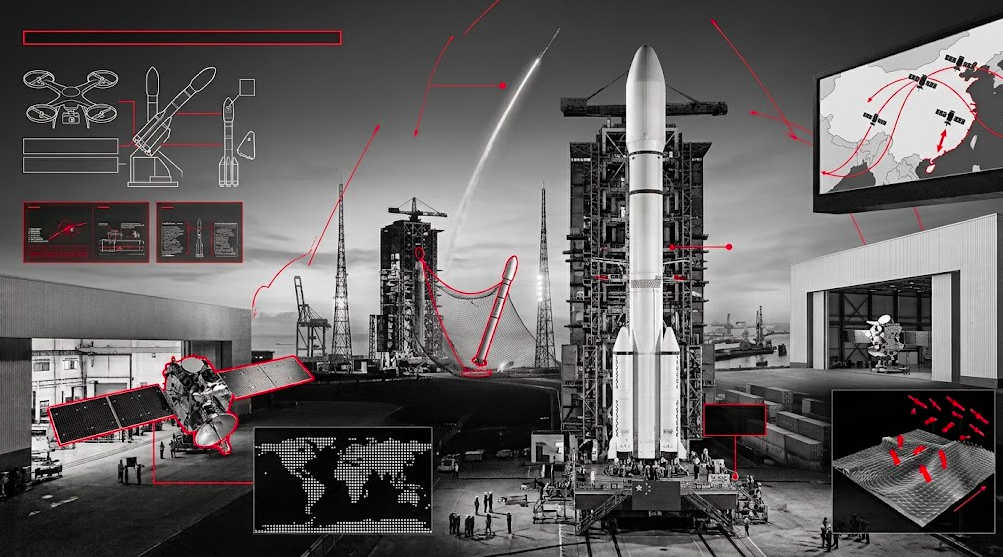
China's prosperity depends on sea-borne commerce that transits exposed chokepoints – from the Strait of Malacca across the wider Indo-Pacific, the Strait of Hormz and the Suez Canal. Its military modernisation has therefore concentrated on naval power, anti-access/area denial systems, and capabilities in space, cyber and the electromagnetic spectrum. Parallel economic statecraft seeks to reshape Eurasia through export dominance, infrastructure, connectivity and finance.
A popular car on London roads is a cheap Chinese version of the Land Rover and Germany's biggest carmaker Volkswagen is planning to lay off thousands of workers. Faced with mounting costs, multinational companies like Siemens are considering shifting manufacture to China, which will improve their balance sheet, but damage society. All of this points to a seaward and westward strategy across Eurasia, not southward into the Himalayas.
Equally important is what Beijing seeks to avoid: a two-front strategic dilemma. Its principal contest is with the US in the maritime domain. Opening a major continental war with India would divert resources and attention, invite external involvement and risk pushing New Delhi into tighter alignment with Washington – strengthening the very coalition that China aims to weaken. Prudence, not diffidence, explains doctrinal silence on India.
China's handling of India is therefore indirect and economical. Over decades, it has systematically strengthened Pakistan's military capacity – conventional systems, missile forces, nuclear capability and enabling technologies including satellite access. The effect is to anchor India's security calculus within South Asia, ensuring that New Delhi must continually hedge on its western front. This constrains India's ability to concentrate on the maritime domain, where geography gives it latent leverage astride key sea lanes of the Indian Ocean – leverage that could, in extremis, threaten China's energy lifelines and prosperity.
The 1962 war offers a revealing precedent. China achieved limited political objectives and then withdrew unilaterally. Declassified material now says that Mao summoned his army commander six months before the war to give him a four-word directive – Teach India a lesson. What lesson? Presumably, India's place in the Confucian order, nothing about territory. Today, in sectors such as Ladakh, Beijing already controls the ground that it considers strategically necessary. Authoritative doctrine does not indicate a requirement for further large-scale territorial acquisition along the Himalayan frontier.
Contemporary posture is consistent with this reading. The People's Liberation Army prepares for limited, high-intensity, short-duration engagements under "local war" conditions – designed to coerce, deter and shape negotiations. Infrastructure build-up in Tibet and periodic standoffs enhance bargaining power. Unlike all other countries, the primary Chinese principle of war is deception. The threat of any territorial penetration into India is precisely that.
China's experience beyond Eurasia reinforces its caution. Ventures into regions such as Latin America, particularly Venezuela, exposed the risks of overreach in areas within the United States' traditional sphere of influence. Financial exposure and political volatility underlined a simple lesson: consolidate influence in Eurasia and the near seas before contemplating wider global contests. The challenge to US hegemony is thus phased and bounded.
A full-scale Himalayan war would cut across this logic. It would disrupt economic stability, internationalise the conflict and risk drawing in external powers. It would undermine China's carefully cultivated image as a stabilising economic actor across Eurasia. Above all, it would distract from the primary theatre of competition – the maritime and technological contest that will decide the balance of power in the twenty-first century. Beijing's continental strategy is to pin India down with a rearmed Pakistan and prevent an Indian maritime rearmament.
The conclusion is straightforward. China does have a grand strategy, and it is disciplined in its priorities. It seeks to reshape the international order by concentrating effort where the stakes are highest: Eurasia and the maritime domain. Within this design, India is a factor to be contained and managed, not a central adversary. A Himalayan war, far from advancing China's objectives, would detract from them. It is, in the final analysis, a strategic sideshow in a much larger contest.
Rear Admiral Raja Menon (retd) is former Assistant Chief of Naval Staff