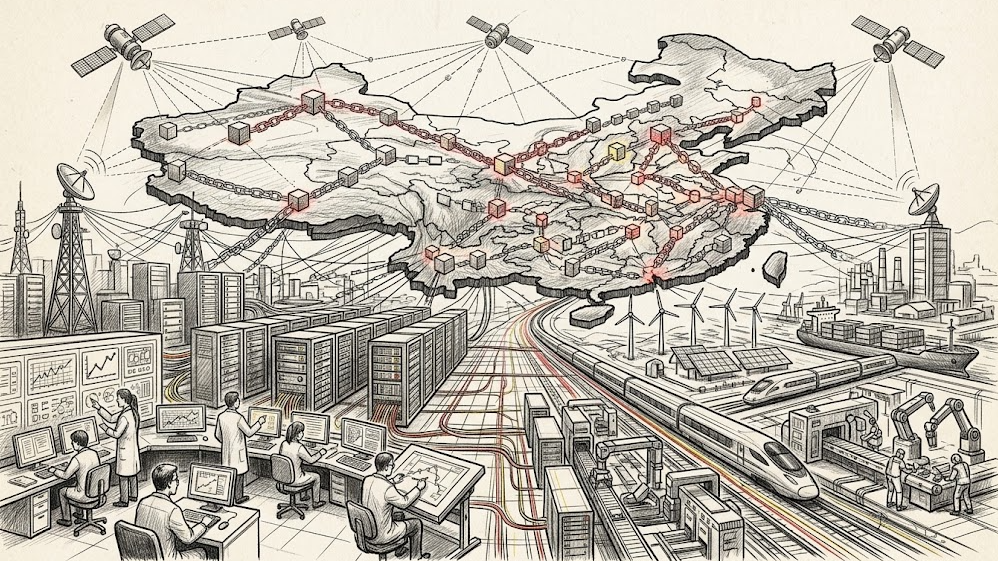
China has successfully landed a massive new undersea data artery in Hong Kong, signaling a significant upgrade to the digital infrastructure connecting the mainland to Southeast Asia as Beijing prepares to export its artificial intelligence and token economy models. China Unicom announced that the Asia Link Cable, or ALC, has officially made landfall, marking the first high-capacity international subsea cable to reach China during the opening year of its 15th Five-Year Plan.
Built by a consortium of 12 domestic and international carriers including China Unicom and China Telecom, the 6,100 kilometer cable is being positioned as the primary digital circulatory system for China’s high-tech expansion into the Asia-Pacific region.
The ALC represents a technological leap in subsea engineering by utilizing the world’s first intelligent optical network submarine cable scheduling system. Working in tandem with the SEA-H2X cable which landed in Hong Kong in late 2025, the new system creates a dual-landing and hot-backup configuration across Hong Kong, Hainan, and Singapore. This architecture allows for millisecond-level automatic link switching and achieves a reliability rating of 99.999 percent. The route covers critical digital nodes including Vietnam, the Philippines, Malaysia, and Brunei, effectively knitting the Association of Southeast Asian Nations closer to China’s domestic cloud and compute infrastructure.
In terms of raw performance, the ALC provides a massive capacity of 27 terabits per second per fiber pair. Critically for the future of regional technology trade, the latency between the Hong Kong, Hainan, and Singapore backbone has been optimized to just 32 milliseconds.
According to industry metrics, the cable is capable of transferring over 80 billion tokens per second, a specification explicitly designed to support large-scale transnational AI scheduling, cross-border inference, and global computing power coordination. This high-speed pipeline is intended to provide the stable and secure international channel required for the "outbound" push of China’s new digital economy and artificial intelligence industries.
The successful landing completes a multi-layered network architecture for China Unicom in the Asia-Pacific, combining traditional cables like APCN2 and APG with a new generation of high-speed links including ADC, SEA-H2X, and ALC. By converging these three new-generation cables in Hong Kong, Beijing is solidifying the city’s status as a premier international digital hub.
This infrastructure is expected to deepen the interconnectivity between the Greater Bay Area, the Hainan Free Trade Port, and ASEAN countries, providing the physical foundation for China’s high-level opening up and regional economic integration. As China builds this technological fortress in the South China Sea, it ensures that the flow of data for the next generation of the internet remains firmly under its strategic influence.