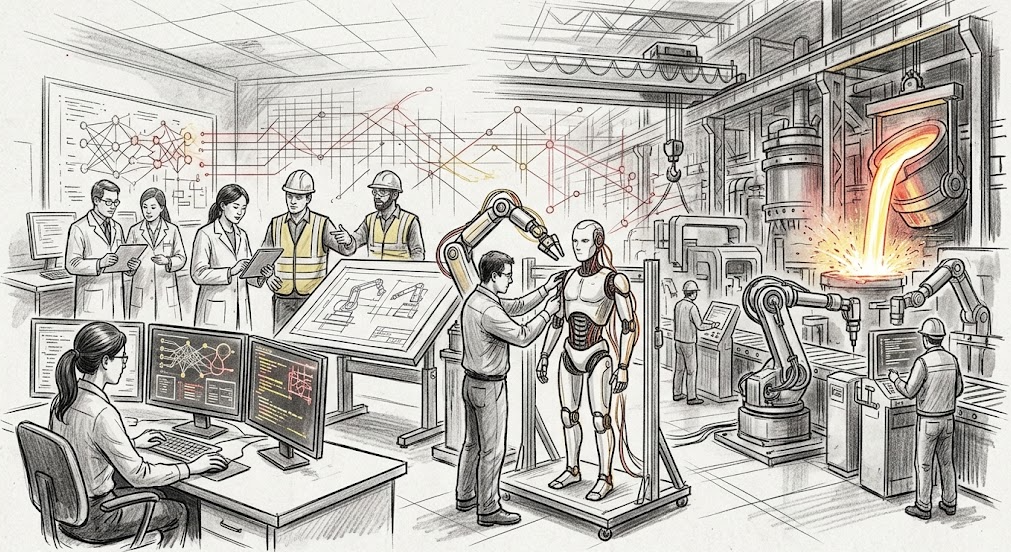
China released a sweeping action plan aimed at driving a new leap in the integration of artificial intelligence and the software and information technology service industry by 2030.
The Ministry of Industry and Information Technology recently printed and distributed the Implementation Plan for the Artificial Intelligence Plus Software Action, introducing the initiative during a press conference held in Beijing. Wang Weiwei, deputy director of the information technology development division at the ministry, stated that artificial intelligence is currently restructuring software product forms and revolutionizing software development models, as traditional software accelerates its intelligent evolution and agent software emerges in new formats.
Under the new action plan, China has established distinct milestones for the coming years. By 2028, the intelligence level of the software and information technology service industry is projected to rise significantly, with promotional applications covering 20,000 above scale software enterprises, 100 software enterprise intelligent technical transformation projects organized cumulatively, 100 agent software benchmark applications built in key industries, and five or more key open-source projects incubated. By 2030, the integration of artificial intelligence and software services is expected to achieve a full leap, propelling China's software sector toward the high end of the global value chain.
The overarching framework deploys work across six key areas, covering software production transformation, intelligent upgrades for software products, the cultivation of new agent software formats, the expansion of intelligent software services, the consolidation of foundational intelligent development, and the optimization of the software industry environment.
Officials noted that the Chinese software industry has established a solid foundation with an overall industry revenue reaching 15.48 trillion yuan in 2025, representing 6.2 times the figure from 2012 at a compound annual growth rate of 15.1 percent. Furthermore, national daily token call volume surpassed 500 trillion as of June 2026.
Detailing the production transformation pillar, China Electronics Information Industry Development Research Institute Vice President Zhu Min explained that intelligent programming represents the most mature and rapidly evolving direction, driving efficiency across entire industrial chains. The ministry plans to optimize intelligent programming tool chains, promote enterprise technical transformation based on code quality and research and development benefits, and embed smart security testing throughout the software development lifecycle.
To support foundational development, OpenAtom Foundation Deputy Secretary General Li Bo highlighted that the AtomGit community accumulated over 80,000 models, 370,000 datasets, and 12 million registered users by August 2026. Additionally, the embodied artificial intelligence open source dataset community OpenLET has gathered over 100,000 minutes of real machine data with more than one million downloads.
Addressing critical software sectors, Wang Weiwei emphasized that the strategy tackles foundational software such as operating systems and databases alongside industrial software like computer aided design, computer aided engineering, and electronic design automation. The initiative supports building more than 15 software and hardware adaptation centers to foster deep integration.
Meanwhile, Zhu Min noted that the plan targets the creation of 100 benchmark agent software applications in key industries, fostering general and vertical professional agents equipped with autonomous perception, decision making, and execution capabilities. China Software Industry Association Vice President and Secretary General Lü Weifeng added that service models are shifting from simple product sales to continuous service operations, giving rise to new paradigms such as model as a service and agent as a service.
To safeguard this rapid transition, the ministry highlighted a dual focus on development and security. Wang Weiwei pointed out that authorities must address internal system risks like model hallucinations and code vulnerabilities alongside external spillover threats such as malicious prompt injections and data pollution, ensuring that smart agents remain completely controllable and traceable. Regarding employment impacts, Lü Weifeng noted that while repetitive coding work shifts to automation, the transition creates new roles including frontline deployment engineers and generative artificial intelligence system application operators, requiring enhanced professional training and human machine collaboration to support high quality industry growth.