China's commercial aerospace sector is undergoing a rapid operational pivot, transitioning from policy-driven research into a high-cadence industrial engine capable of fielding low-Earth orbit constellations and executing rapid-response space missions. Backed by state capital and regional defense-industrial hubs, the domestic commercial space market is projected to surpass 3.5 trillion yuan ($495 billion) in 2026, driven by high-density launch sorties, direct-to-cell satellite networks, and tactical remote-sensing capabilities.
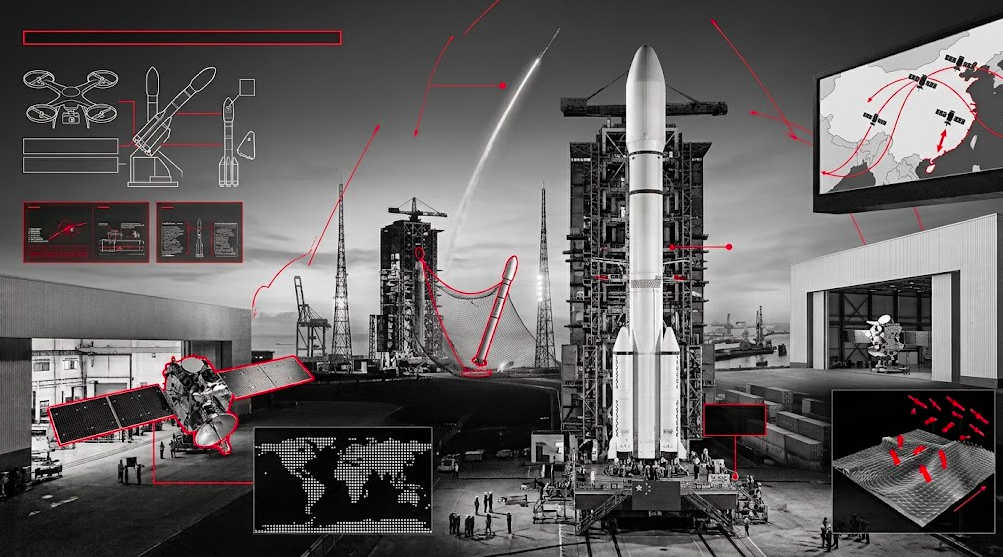
At the centerpiece of this operational expansion is the Hainan Commercial Space Launch Site, which has completed 23 successful launch sorties to date. The seaside facility recently supported the orbital flight of the Long March 10B launch vehicle, which achieved the world's first sea-based net recovery of a booster stage. According to Hainan provincial officials, the surrounding Wenchang International Aerospace City has established a fully integrated defense-industrial triad encompassing rocket manufacturing, satellite assembly, and ground-station telemetry processing. The site features an automated satellite super-factory equipped for end-to-end payload integration, environmental stress testing, and pre-flight validation.
To maintain high-volume operational readiness, Hainan authorities established a specialized standardization committee in 2026, enforcing strict enterprise protocols known as "Quality Zeroing" to eliminate technical defects across critical rocket structures, satellite payloads, and space-ground telemetry links. Officials noted that future strategic planning will prioritize low-latitude launch metering and satellite data quality assessment to establish a standardized operational blueprint for national commercial spaceports.
The rapid maturation of the sector reflects a structural evolution in how China mobilizes space hardware. While the initial wave of commercial aerospace ventures a decade ago relied on private venture capital to build technical capabilities from scratch, a new category of "Type II" defense-industrial entrants is now dominating the landscape. These entities enter the market with pre-existing missile and rocket designs, state-backed manufacturing infrastructure, and direct access to regional supply networks.
A prime example of this model is Kuaizhou Aerospace Space Technology Co. Ltd., which completed its 40th launch sortie with the Kuaizhou-11 rocket on Sept. 17. Originally developed under state defense giant CASIC, the enterprise was restructured in 2026 following a 3.3 billion yuan equity acquisition led by Wuhan state-owned capital funds. Similarly, Western Aerospace Technology was established in Xi'an in March with 500 million yuan in registered capital, consolidating heavy forging, environmental testing, and propulsion research from local defense institutes into a unified operational prime contractor.
Industry analysts note that while early commercial startups focused on achieving basic orbital insertion, regulatory authorities now require listing candidates on the Shanghai Stock Exchange STAR Market to demonstrate successful orbital deployment using medium-to-heavy reusable rockets. Earlier years required proving that a private company could build a rocket, but the current imperative is delivering reliable, low-cost launch capacity to customers on a continuous operational schedule.
That operational throughput was demonstrated in mid-September when domestic launch providers executed six rocket sorties in a single seven-day window. Utilizing Lijian-1, Kuaizhou-11, and Long March-12 vehicles, operators successfully inserted more than 30 satellites into target orbits, underscoring China's capability for rapid constellation replenishment and dedicated tactical deployments.
Simultaneously, municipal industrial hubs are fielding specialized satellite constellations to support high-value maritime and economic infrastructure. On Sept. 20, the coastal manufacturing center of Ningbo initiated deployment of the "Zhiyi Constellation," a planned 108-satellite low-Earth orbit network operated by Zhenyou Technology subsidiary Zhenyou Weitong. The orbital grid is engineered to provide continuous, high-resolution 3D wind-field mapping and weather telemetry for maritime shipping corridors, offshore wind farms, and low-altitude airspace management.
"Conventional ground-based meteorological networks have limited observation capabilities far offshore, and existing satellites lack the fine spatial-temporal resolution needed for high-sensitivity operations," said Guo Jianxia, chief expert at the China Meteorological Administration's Observation Center. "The Zhiyi Constellation relies on LEO multi-satellite networking to deliver high-resolution wind-field monitoring, providing critical data to track rapid atmospheric dynamics that directly impact operational safety."
Addressing the commercial and operational strategy behind the constellation, Zhenyou Technology Chairman Wu Minhua highlighted the focus on sustained data-processing loops. "Our core advantage centers on inter-satellite and space-to-ground core networks," Wu said. "The primary gap among commercial space firms today lies in operational execution capability. Our immediate task is to seize this time window and turn the Zhiyi Constellation into an operational, manageable, and profitable wind-field data factory."
Investment leaders echoed the necessity of demand-driven space assets. "The market is saturated with rocket and satellite manufacturers competing for limited orders," said Chengxing Communication Chairman Jia Pengcheng. "Projects like the Zhiyi Constellation generate continuous cash flow from end-users, creating a self-sustaining commercial loop that actively purchases launches and hardware." Ningbo Science and Technology Bureau Deputy Director Wang Shu added that aerospace technology has become a vital strategic thrust for expanding regional industrial competitiveness, fusing space-based sensing directly into local manufacturing and maritime operations.